Nielsen finds ‘second screen’ viewing enhances TV experiences

When viewers watch a TV program with a tablet device, they tend to check their email, hunt for sports scores or seek additional information about the show or a commercial they were watching on the big screen.

A new report by Nielsen Co., underscores what network television researchers have been preaching for more than a year: that “second screen viewing” appears to augment the TV viewing experience rather than steal away viewers.

Nielsen’s State of the Media: Advertising & Audiences report found that men, when watching TV and using a tablet simultaneously, were more likely than women to look for information related to a TV program they were watching (39% versus 34%).

Women were more inclined to seek information related to a television commercial (24% versus 21%).

Not surprisingly, teenagers with tablets were far more apt to visit a social media site while watching TV than were older baby boomers and seniors (62% versus 33%).

The report also found cultural differences in TV watching and the use of digital video recorders. Nielsen said that white TV viewers use digital video recorders on a daily basis twice as much as any other group, while Asian Americans appear to spend a higher proportion of their overall TV time watching their previously recorded programs.

Adults age 25 to 54 appear to be heavily influenced by advertising. Nielsen said that demographic group was 23% more likely than the average U.S. Internet user to follow a brand through social networking sites, and 29% more likely to purchase a product online that had been featured on TV.

Not all TV Should be Social TV

As one could imagine, I end up in a lot of conversations about second screen TV apps, companion apps, social TV, etc.  Virtually every discussion takes some long varied road to get to a point where all involved agree that the only rule in building next generation TV platforms and products is this: not all TV shows are alike, and experiences must be built with this rule in mind.

Let’s start with #SocialTV – broadly defined in current terms as “people tweeting, checking in, and liking TV shows on social media platforms.”  While I’m pretty jaded in my belief that this is resoundingly uninteresting as a topic, it’s important to think of it on a per-genre basis, and in fact, a per show basis.  One could state that “dramas” for example won’t garner much social TV activity – who really cares about checking in to shows like CSI or House?  Then along comes Game of Thrones, rule broken.  Then you could use Game of Thrones data to claim people don’t tweet while watching live TV.  And along comes sports and reality shows.

When it comes to planning and thinking about how users may/will behave regarding social TV and shows, I recommend thinking about it from two perspectives: (1) live interaction and (2) cultural impact.  The personal drivers for a lot of these activities have to do with the social perspective.  People are interested in “connecting” with others, which drives the interactions (tweeting about your team, someone getting voted off the island, etc).  People are also interested in being part of the cultural zeitgeist – Game of Thrones is “in” and “cool” to tweet about, whereas CSI and House are not.

Next up are companion apps – smartphone and/or iPad apps designed for use during a TV show.  As above, the potential value creation here is entirely about the content.  Do users really want to pull out their phones and read trivia while watching an intense or immersive show like Game of Thrones or The Good Wife?  Doubtful.  Am I going to look away from a visually-rich experience such as Planet Earth? Or how about Family Guy, where half the show is visual gags?  Seems unlikely.  But during any reality show, game show, talk show, or sports? I’d guess there’s a huge opportunity here.

Same moral as above, the right companion apps keep the content in mind.  First, we really don’t need (or want) a dedicated companion experience for every single show that airs – it’s just plain unnecessary.  But regardless of that, the experiences should think about the audience and how they want to interact.  Sports is all about real-time and stats.  Cooking shows, on the other hand, don’t need a real-time experience, but yet offering recipes, how-to, pictures, etc that can be bookmarked, archived, and viewed in the future is quite handy.  Complicated plot-driven shows can offer complementary experiences that supply background or other pertinent information to help audiences keep up with whatever’s going on.

Enhanced content offerings – featurettes, behind-the-scenes, and other options that plunge the user in a further immersive landscape blah blah blah. Now, speaking as the guy who watched all 3 Lord of the Rings movies, extended cut, with director’s commentary on, there’s no question a marketplace exists for extra content.  Blooper reels.  Making-of’s.  Interviews with Cast & Crew.  The key focus again is identifying the right content for the right show and deploying it in the right place.

Do I really need a dedicated app for my iPad just to get extra content for each show I like?  Do I need to subscribe to something?  I think, fundamentally, content creators and technologists need to really spend time crafting the right offering for each individual show.  For example, having the “webisodes” of The Office available openly via Facebook each week is a great solution to enhance that offering.  But if I needed an Office app, with a new Office username and password, would it be worth the investment beyond the “Like”?  Doubtful.

Overall, the time has come for TV technologists, creators, producers, etc to work together to avoid one-size-fits-all approaches to TV experiences.  Every show, every network, every device, and every platform should be regarded as a unique opportunity to engage an audience and tell a story.  Except, of course, for reality shows about celebutantes, which should just go away. Please folks, just do the right thing here. We can do it!

by Jeremy Toeman

Can Social TV Save Live Televison?

For decades, technology has chipped away at TV. VCRs, streaming Internet video, file sharing, DVRs, on-demand cable and mobile video provided TV alternatives, decreased TV’s audience, increased time shifting or encouraged ad skipping. One of the intriguing things about social media is that it is the first technological advance that really benefits TV without specifically being about TV.

Of course, television was social before we had social media. TV shows drove “water cooler” chatter since Lucy Ricardo gave birth to “Little Ricky” – 71.7% of all American TV sets were tuned to “I Love Lucy” the night Lucille Ball’s character gave birth in 1953. Crowdsourcing is not new to television, either; letter writing campaigns to save TV shows date back to at least 1968 when fans got NBC to renew “Star Trek” for another season. The fact TV viewing is innately social makes it the perfect match for today’s social media and mobile technology.

With the real-time sharing that happens via social media, it once again seems exciting and necessary to watch live TV. No one wants to see spoilers of their favorite shows–a recent TV Guide study found that 27 percent of us are watching more live TV to avoid plot and reality spoilers revealed on social networks. People may hate them, but don’t expect TV networks to make it any easier for you to avoid those spoilers; hashtags are popping up in the corner of TV screens to encourage viewers to join the dialog on Twitter. According to Chloe Sladden, Twitter’s director of content and programming, those perpetual hashtags can at least double the amount of activity and could drive as much as 10 times the tweets.

The power of real-time social media to drive TV viewership was demonstrated last year when Charlie Sheen made an 11th-hour appearance on CNN’s “Piers Morgan Tonight.” Though the show had almost no advance promotion, social networks lit up once the interview began, and 45 minutes into the show, viewership in the 25-to-54 demo was up 61%.

Networks are also encouraging real-time social media engagement with their shows by making stars and reality TV contestants available to fans. The competitors on The Voice are encouraged to tweet and connect with their fans, quite a change from when American Idol prevented contestants from having active Myspace pages or Twitter accounts. In addition, more and more networks are increasingly featuring stars in Twitter chats while their shows are broadcast.

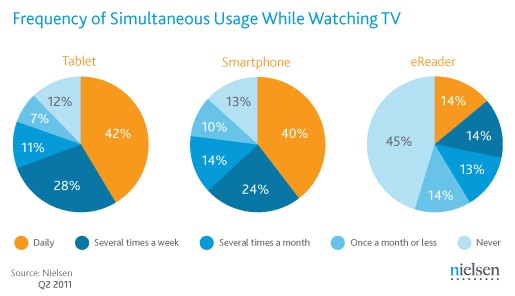
The growth of mobile technology is powering multitasking and sharing while watching TV. According to Elizabeth Shaw’s recent Forrester report, almost two-thirds of Gen X and three-quarters of Gen Y consumers go online while watching television. Further evidence comes from Nielsen, which found that 88 percent of tablet owners and 86 percent of smartphone owners used their devices while watching TV at least once during a 30-day period. It turns out this behavior is extremely common–roughly two-thirds of these folks use their device while watching television at least several times a week.
Today’s Social TV is being powered by more than just Twitter and Facebook; new sites and tools such as GetGlue are focused on increasing social engagement around live TV. GetGlue only has 2 million users, but it has already driven 100 million check-ins (although entertainment check-ins have a long way to go to catch Foursquare’s 2 billion location check-ins.) Many other tools, including some created by the networks themselves, seek to drive more Social TV activity. Other sites and apps include MTVWatchWithNBC Live, IntoNow, Miso and show-specific apps such those for Bones, Celebrity Apprentice and New Girl.

Between GetGlue, Twitter, Facebook, blogs and boards, lots of us are talking about TV, and this is not just common among teens; in fact, according to Nielsen, people who talk about TV shows online skew older. The 25- to 34-year-old demographic accounts for just 17 percent of the overall social media population but is responsible for 29 percent of those on sites talking about TV.

All the check-ins, tweets and posts are having an effect. TV Guide’s study found that 17 percent of respondents say they have started to watch a show and 31 percent say they have continued to watch a show because of a social impression.

Another study by NM Incite, a Nielsen/McKinsey Company, found a complex relationship between social media buzz and TV ratings. Buzz most closely correlated with increased TV viewership in consumers aged 18 to 34; in this demographic, a 9% increase in buzz volume around the time a show premiered correlated to a 1% increase in ratings, but as the season wore on, the relationship between the two variables weakened. However, with older viewers, social buzz had a greater impact on ratings toward the end of the season than at the beginning or middle.

In addition to driving attention and viewership in shows, TV networks are also using social media data to tweak their shows to be more appealing to viewers. The producers of the 2010 MTV Video Music Awards focused more attention on Lady Gaga after her meat dress became a trending topic on Twitter. Simon Cowell, who once criticized celebrities on Twitter by asking, “Why would you want to talk to people like that?”, now uses audience feedback from Twitter to influence the format of The X Factor and tweets regularly at @simoncowell. New services such as Trendrr.TV are giving networks reams of data to measure viewer affinity not just for shows but also for granular attributes such as plotlines and characters.

The opportunities in Social TV will only continue to grow as more case studies demonstrate success. The 2012 Video Music Awards (VMAs) is one such success story. MTV pushed the #VMA hashtag using a Promoted Trend and on-screen text during the broadcast. It also hosted an online “Twitter Tracker” site during the award ceremony and displayed the results during commercial breaks to attendees in the theater to encourage their participation online. MTV’s microsite even featured a seating chart of the theater to see the spots from which celebrities were tweeting.

The social promotion effort worked. Twitter saw over 10 million VMA Tweets, and the Promoted Trend had a 16% engagement rate, driving 27 times the average mentions of MTV’s Twitter account and adding 128,000 new followers to MTV’s Twitter account on the day of the event. The social media activity contributed to the success of the 2012 VMAs broadcast–it was the largest audience ever for any telecast in MTV’s history.

TV Everywhere Finally Becomes a Reality

NimbleTV.com has announced a game changing new subscription-based TV platform that enables customers to access their television from anywhere in the world, on any device.

Customers can access their subscription TV service using NimbleTV cloud-based software that lets them view their TV wherever they are – with nearly unlimited recording capability and social tools to help guide what to watch. The service is a global platform beginning with TV offerings from the U.S. and India, and will roll out to other countries.

“NimbleTV is based on the simplest idea: customers should be able to access the TV they pay for wherever they happen to be,” said CEO Subramanian. “Today, the groundbreaking technology behind our service makes ‘TV everywhere’ a reality – with more options, high-quality viewing on any device, watchable from anywhere. Our model is predicated on the belief that providers and content producers should be paid. NimbleTV is a solution that’s both consumer friendly and industry friendly.”

NimbleTV sets customers up with their own subscription agreements with TV providers that NimbleTV supports. Customers make payments directly to their providers with NimbleTV acting as a payment service. In addition to local coverage, NimbleTV includes all cable channels, depending on which package a customer selects. The service has more than 10,000 hours of digital recording. There is no box to buy or equipment to set up. NimbleTV has built-in social features that enable customers to easily follow and record what their friends like to watch on TV.

Four Reasons to Pay Attention to Social TV

Within the broadcast and social-media-analytics worlds, as well as the broadcast-obsessed agency and marketer universe, the term “social TV” is uttered and heard endlessly these days. But not everyone understands the meaning of the term.

The short answer is Millions of people are now partaking in “dual-screen” experiences — watching TV while using a smartphone (or tablet) to share (primarily on Twitter and Facebook) their thoughts about what they’re viewing and to “check in” to shows (on services like GetGlue). The result: a massive and rapidly expanding real-time focus group (and promotional force).

Here are four good reasons, highlighted by Ad Ag
e, of why social TV actually matters:

Social TV can increase ratings.
At the 2012 Social TV Summit, Deirdre Bannon, VP-media analytics at Nielsen, shared the result of research the company has been conducting during the past year. (It began releasing research on the social-TV-to-ratings connection last October.) The main takeaway: For key demos, social buzz surrounding shows can increase ratings.

For instance, Nielsen says a 9% to 14% increase in buzz volume (depending on where a particular show is in its season) correlates to a 1% increase in ratings in the 18-to-34 demo. That’s obviously not enough to make or break a show, but it’s enough to matter. It’s also worth noting that ratings seem to be most susceptible to social influence when it comes to season premieres and finales — i.e., the pivot points that are heavily marketed in traditional, nonsocial media (especially network promos).

Social TV can make TV better.
Chris Stephenson is both a hard-charging new-media executive as president of Viggle — the “loyalty program for TV” that launched in January — and a pop-culture addict who takes naked delight in making what’s fun TV even … funner. “People talk a lot about ‘social TV,'” Stephenson told me over coffee in San Francisco, “but we don’t think that way at Viggle. We think more about ‘better TV.’ We want to add a layer of enjoyment to television-watching which enhances the experience and rewards people for their loyalty and engagement. While many of the social-TV apps rely on the basic principle of ‘sharing my check-ins,’ we think about deep engagement, polls, trivia, mood-o-meters, etc.”

Social TV can get consumers to engage with shows (and brands) far beyond the broadcast window.
“We provide custom metrics depending on what our sponsors are looking for,” said USA Network senior VP-Digital Jesse Redniss, speaking of the various social-TV programs he and his team have devised over the past few years. “Nobody is really saying, ‘We want to get clicks.’ Nobody cares about the click anymore; the click is pretty much dead. Marketers really want engagement over time: ‘People viewed our vehicle for X amount of time.’ Or, ‘We want people to experience all the cool attributes of what our brand represents.'”

In the case of its hit show “Burn Notice,” for instance, USA Network produced two “seasons” of the “Burn Notice: A New Day” digital graphic novel (aka tablet comic book), sponsored by Hyundai, whose vehicles are featured in beautifully drawn, interactive storylines that have baked-in Twitter and Facebook connections. Fans of “Burn Notice” might watch every episode — hardcore fans might even watch reruns, too, to catch nuances they missed on first viewing. But that’s about it. Through TV alone, USA and its sponsors have a hold on viewer attention for a finite set of hour-long chunks for its dramas. But done right, social-TV initiatives like the “Burn Notice” comic book can strengthen engagement by deepening the narrative pre- and post-broadcast.

Social TV can provide tons of new ‘hooks’ for marketers.
Earlier this month in his company’s headquarters Watchwith CEO and co-founder Zane Velthe revealed the system his company has developed to provide what he calls a “time-based metadata” platform to power social-TV apps.

“We’re creating a world where every frame of TV is rich in possibilities,” he said, sounding every bit the on-pitch evangelist. But the proof is in the pop-ups — the visual manifestation in Watchwith’s back end (not visible to viewers) that creates second-by-second data bubbles that display what the database “knows” about every given scene. In an episode of social-TV (and ratings) hit “The Big Bang Theory,” for instance, a character walks into a room and the Watchwith database serves up information (which in turn feeds into social-TV apps) about exactly which model of Jansport backpack he’s carrying.

Consider that Watchwith — which just rebranded from its nerdy previous incarnation, Related Content Database — has been working with major broadcast and cable networks, social-TV startups and e-commerce players including eBay.

Now consider what can happen when such product-smart metadata gets synced with the crowdsourced data that more and more TV viewers are producing themselves during every scene of all their favorite shows. You can begin to understand where the whole social-TV phenomenon, and media engagement in general, is going.

Read More at Ad Age