Food Network Launches “Discover Food Network” Channel on SnapChat

https://www.youtube.com/watch?v=UbOMqA2AOIk

Popular messaging app Snapchat announced today that it has partnered with top media media brands, including Food Network, in order to launch a new in-app news feature that will allow users to access a collection of the day’s top stories and videos with just one swipe.

The app’s new ‘Discover’ feature includes 12 unique news channels, one for each media partner, plus a dedicated Snapchat channel which will include original content from the app’s creators.

With the move, Snapchat is positioning itself as a media platform — one that reaches an estimated 100-plus million monthly active users. Snapchat Discover will compete with other video platforms and services that encompass video, including YouTube, Facebook and Twitter. Every channel in Snapchat Discover is refreshed after 24 hours, “because what’s news today is history tomorrow,” the company explained.

Food Network is Snapchat’s exclusive launch partner within the food category. The Discover Food Network channel on Snapchat extends the Food Network brand to reach even more young consumers with new and exciting content tailored specifically for that audience. As well as being an engaging new channel for young food fans, Discover Food Network on Snapchat will provide a new opportunity for advertisers to reach engaged young people who love food.

“Food Network has led the dialogue around food for more than two decades, informing and entertaining passionate and engaged fans, and we are excited to bring it to the Snapchat platform,” says Brooke Johnson, President of Food Network & Cooking Channel. “Audiences are more food-conscious than ever before and the Discover Food Network channel on Snapchat will provide users with the great content they love, designed specifically for their mobile devices.”

Users can tap on a channel and swipe left to flip through each channel’s daily edition, containing five to ten stories selected for the service by the Food Network editorial team.

The expectation is that some consumers will discover Food Network content through Snapchat, then seek more through Food Network’s television channels, digital and mobile platforms.

Three Trends Digital Marketers Need to Watch.

emarketer
If you’re looking for digital marketing trends for the upcoming year, go to a company that follows the industry trends.
eMarketer just released their report on the key digital trends for 2015. Here are three important trends to keep your eye on:

1) Programmatic will move Beyond Display Advertising

Another tipping point in 2015: programmatic advertising.
We expect programmatic will cross the line to make up
more than 50% of all digital display advertising.
But the story of programmatic will go much further than
display next year.
The same momentum and technologies that have
reshaped how we buy display ads could eventually
transform how we buy all forms of advertising, not
just digital but traditional as well. Programmatic TV, for
example, accounts for less than 1% of all TV ad spending,
but some predict it could be a multibillion dollar industry
within 12 to 24 months as both buyers and sellers use it
to better understand their audiences.
Some forecasts have that number jumping to as much as
20% of all TV spending by 2018. That’s a huge increase,
and even if it’s half or a quarter of that, we’re still talking
about very big money here. Expect the tide to begin to
turn in 2015

2) Cord-Shaving

Yes, some consumers are cutting the cord, but they’re
in the low single digits percentage-wise. A more real
behavior is cord-shaving, where consumers reduce what
they spend, rather than eliminating it altogether.
Individuals in all age groups are still watching a ton of TV
the traditional way, even millennials.
Of course, now that HBO has announced plans to
offer HBO GO as a standalone service, all of that could
change, especially as other networks rush to follow suit.
So, as they say, don’t touch that dial: Unbundling could
accelerate consumers’ latent thirst for cord-cutting.
What that means is you need to pay close attention to
consumers’ shifting video consumption habits.

TV is holding steady. It’s still the media big dog … for now. But
mobile is the channel that’s growing. With all the time,
money and attention flowing to digital video, marketers
that lack deals with content owners and dynamic
advertising are going to miss the boat.

3) Social TV

Consumers regularly use mobile devices while watching TV, but only a small percentage
talk about what they are watching via social media.
TV-related conversations are also fragmented across
platforms, and industry executives are still unsure of the
effect of social media on people’s viewing behaviors or
on ratings.

Consumers aren’t really engaging in social TV marketing
efforts, and marketers are holding back as a result. That’s
not going to change in 2015.

Can Social TV Save Live Televison?

For decades, technology has chipped away at TV. VCRs, streaming Internet video, file sharing, DVRs, on-demand cable and mobile video provided TV alternatives, decreased TV’s audience, increased time shifting or encouraged ad skipping. One of the intriguing things about social media is that it is the first technological advance that really benefits TV without specifically being about TV.

Of course, television was social before we had social media. TV shows drove “water cooler” chatter since Lucy Ricardo gave birth to “Little Ricky” – 71.7% of all American TV sets were tuned to “I Love Lucy” the night Lucille Ball’s character gave birth in 1953. Crowdsourcing is not new to television, either; letter writing campaigns to save TV shows date back to at least 1968 when fans got NBC to renew “Star Trek” for another season. The fact TV viewing is innately social makes it the perfect match for today’s social media and mobile technology.

With the real-time sharing that happens via social media, it once again seems exciting and necessary to watch live TV. No one wants to see spoilers of their favorite shows–a recent TV Guide study found that 27 percent of us are watching more live TV to avoid plot and reality spoilers revealed on social networks. People may hate them, but don’t expect TV networks to make it any easier for you to avoid those spoilers; hashtags are popping up in the corner of TV screens to encourage viewers to join the dialog on Twitter. According to Chloe Sladden, Twitter’s director of content and programming, those perpetual hashtags can at least double the amount of activity and could drive as much as 10 times the tweets.

The power of real-time social media to drive TV viewership was demonstrated last year when Charlie Sheen made an 11th-hour appearance on CNN’s “Piers Morgan Tonight.” Though the show had almost no advance promotion, social networks lit up once the interview began, and 45 minutes into the show, viewership in the 25-to-54 demo was up 61%.

Networks are also encouraging real-time social media engagement with their shows by making stars and reality TV contestants available to fans. The competitors on The Voice are encouraged to tweet and connect with their fans, quite a change from when American Idol prevented contestants from having active Myspace pages or Twitter accounts. In addition, more and more networks are increasingly featuring stars in Twitter chats while their shows are broadcast.

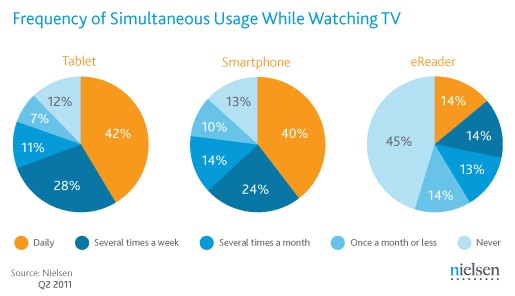
The growth of mobile technology is powering multitasking and sharing while watching TV. According to Elizabeth Shaw’s recent Forrester report, almost two-thirds of Gen X and three-quarters of Gen Y consumers go online while watching television. Further evidence comes from Nielsen, which found that 88 percent of tablet owners and 86 percent of smartphone owners used their devices while watching TV at least once during a 30-day period. It turns out this behavior is extremely common–roughly two-thirds of these folks use their device while watching television at least several times a week.
Today’s Social TV is being powered by more than just Twitter and Facebook; new sites and tools such as GetGlue are focused on increasing social engagement around live TV. GetGlue only has 2 million users, but it has already driven 100 million check-ins (although entertainment check-ins have a long way to go to catch Foursquare’s 2 billion location check-ins.) Many other tools, including some created by the networks themselves, seek to drive more Social TV activity. Other sites and apps include MTVWatchWithNBC Live, IntoNow, Miso and show-specific apps such those for Bones, Celebrity Apprentice and New Girl.

Between GetGlue, Twitter, Facebook, blogs and boards, lots of us are talking about TV, and this is not just common among teens; in fact, according to Nielsen, people who talk about TV shows online skew older. The 25- to 34-year-old demographic accounts for just 17 percent of the overall social media population but is responsible for 29 percent of those on sites talking about TV.

All the check-ins, tweets and posts are having an effect. TV Guide’s study found that 17 percent of respondents say they have started to watch a show and 31 percent say they have continued to watch a show because of a social impression.

Another study by NM Incite, a Nielsen/McKinsey Company, found a complex relationship between social media buzz and TV ratings. Buzz most closely correlated with increased TV viewership in consumers aged 18 to 34; in this demographic, a 9% increase in buzz volume around the time a show premiered correlated to a 1% increase in ratings, but as the season wore on, the relationship between the two variables weakened. However, with older viewers, social buzz had a greater impact on ratings toward the end of the season than at the beginning or middle.

In addition to driving attention and viewership in shows, TV networks are also using social media data to tweak their shows to be more appealing to viewers. The producers of the 2010 MTV Video Music Awards focused more attention on Lady Gaga after her meat dress became a trending topic on Twitter. Simon Cowell, who once criticized celebrities on Twitter by asking, “Why would you want to talk to people like that?”, now uses audience feedback from Twitter to influence the format of The X Factor and tweets regularly at @simoncowell. New services such as Trendrr.TV are giving networks reams of data to measure viewer affinity not just for shows but also for granular attributes such as plotlines and characters.

The opportunities in Social TV will only continue to grow as more case studies demonstrate success. The 2012 Video Music Awards (VMAs) is one such success story. MTV pushed the #VMA hashtag using a Promoted Trend and on-screen text during the broadcast. It also hosted an online “Twitter Tracker” site during the award ceremony and displayed the results during commercial breaks to attendees in the theater to encourage their participation online. MTV’s microsite even featured a seating chart of the theater to see the spots from which celebrities were tweeting.

The social promotion effort worked. Twitter saw over 10 million VMA Tweets, and the Promoted Trend had a 16% engagement rate, driving 27 times the average mentions of MTV’s Twitter account and adding 128,000 new followers to MTV’s Twitter account on the day of the event. The social media activity contributed to the success of the 2012 VMAs broadcast–it was the largest audience ever for any telecast in MTV’s history.