
Paying for TV has been a curious consumer phenomenon. There was a time when TV was free to consumers. It was delivered as a broadcast over-the-air and paid for either by commercials (US) or by taxes on viewers (Europe mostly).
The big shift was convincing consumers to pay for something that used to be free. The initial benefit was that the quality of the picture would be much better. The second benefit was an increase in the number of channels. VHF and UHF television would cover about three and 5 channels respectively while cable could offer dozens, many specializing on specific types of content like the Home Box Office (HBO) offering movies and ESPN offering sports only and MTV music videos and CNN news only.
These benefits were very attractive during the 1980s, to the extent that about 60% of US households adopted cable. An additional group later adopted satellite-based pay-TV as the technology became reasonably affordable.
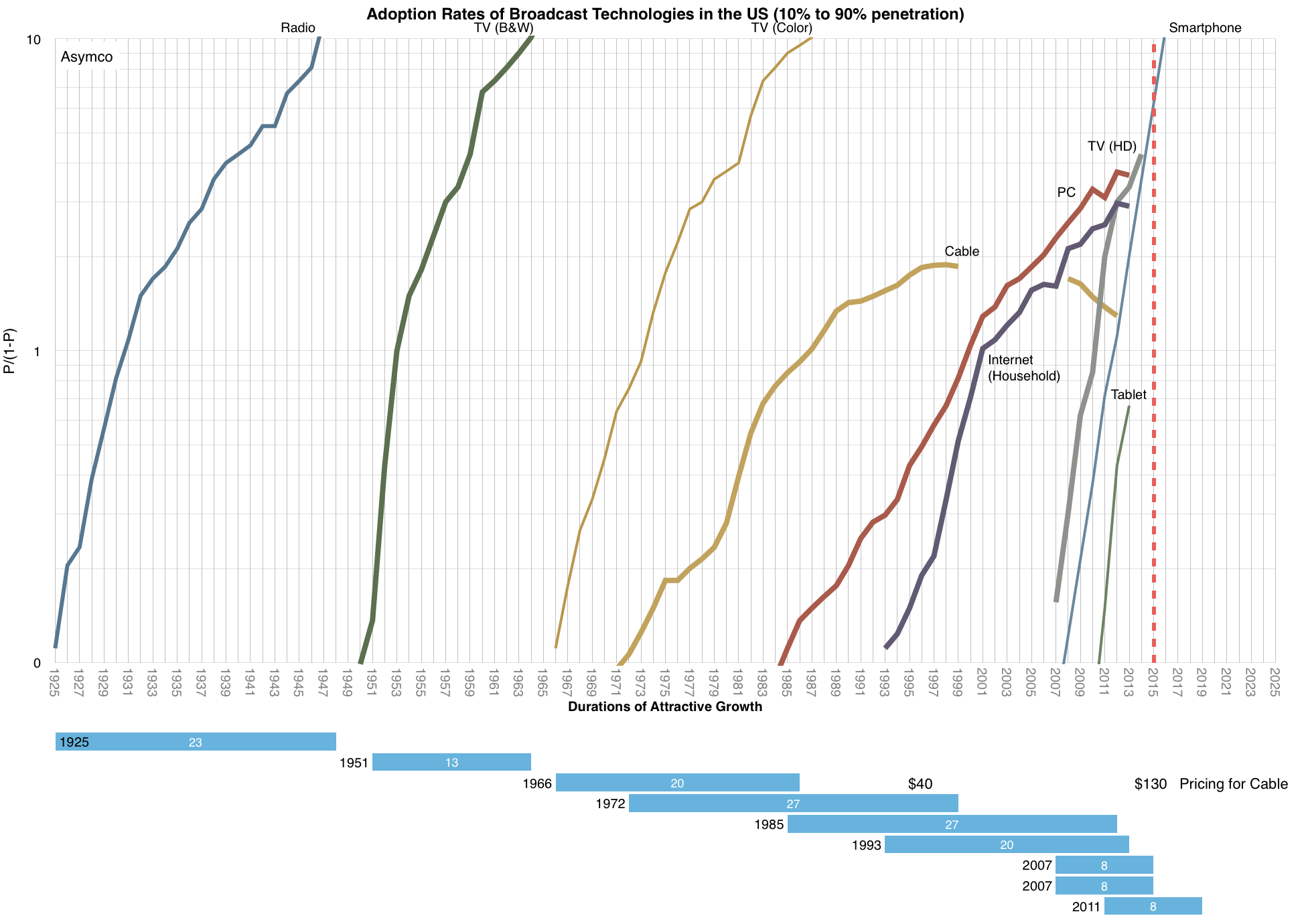
These benefits were priced modestly but as the quality and breadth of programming increased, prices rose. An average cable bill of $40/month in 1995 is $130 today. Some of that revenue went into upgrading the capital equipment and higher production values, but more went to the sports leagues and their players whose business models increasingly depended on broadcast rights.
And so over a period of about 40 years, watching TV went from free to quite expensive. More expensive even than a family’s communications costs (i.e. telephone service.) That’s quite an achievement at a time when technology disruption caused huge price reductions in other goods and services.
Over time, some of the benefits began to be less relevant. Commercials are more abundant than ever. The quality of the TV picture is actually worse due to compression than one might get with over-the-air digital broadcast. Finally, the abundance of channels is beyond anyone’s absorption rate. Those channels which used to be “pure” became polluted and undifferentiated as each tried to be the other.
On top of these paradoxes is the fact that actual penetration of the service has been declining. As the graph above shows, Cable TV has declined (though Pay TV much less so). The industry has reached saturation decades ago and has not offered anything meaningful in terms of innovation.
Disruption theory suggests that once a product over-serves on meaningful bases of value creation (and underserves on value) it opens the door to disruption. Which leads to the question. Has cable past its prime time? Twenty years have passed since the industry reached saturation and prices keep rising. The average cable bill is projected to rise to over $200/month by 2020.
This has left the industry open for disruption. Users are cutting cords, the “uncabled” or “never-cabled” are a significant portion of the population. 13.5% of broadband households with an adult under 35 have no pay-TV subscriptions. 8.6 million US households have broadband Internet but no pay-TV subscription. That’s 7.3% of households, up from 4.2% in 2010. Another 5.6 million households “are prime to be among the next wave of cord-cutters,” according to Experian.
The same phenomenon occurred with mobile vs. fixed telephones. For several years it seemed that mobile was sustaining to fixed or that fixed was immune due to lock-ins. The fixed telephone incumbents insisted that the data was inconclusive. Then the trickle of abandonment turned into a waterfall. The quality of service for mobile kept increasing and, with data, it became clear that the mobile devices could unleash a new wave of functionality and value. The same phenomenon occurred again as the music industry shifted from CD’s to digital.
And so it goes. A business dies first slowly then quickly. The exact timing is tricky because of the non-linearity of the phenomenon. It’s also hard to declare end-of-life since business zombies will try to hold on to life as long as possible. What is clear however is that the economics will change dramatically and the alliances between talent and distribution will shift to entrants and away from incumbents. The point when we look back and say that cable as we know it was finished could come by the end of this decade.
 davidgriffith.blog