The media industry is racing toward an Internet-TV future at a breathtaking pace. But the swift changes, highlighted by efforts from Apple Inc., Dish Network Corp. and others, are giving consumers an array of confusing options and forcing entertainment giants to confront some sober realities.
Not long ago, consumers who wanted to watch “Monday Night Football” on ESPN, “Mad Men” on AMC or “Game of Thrones” on HBO knew what they had to do: shell out for a cable package that typically costs around $90 a month in the U.S. They could catch old seasons of popular shows on Netflix or a similar streaming on-demand service, but live, up-to-date programming lived in the cable bundle.
In the span of a few months, tectonic shifts are remaking a television landscape it took decades to sculpt, opening up a range of other possibilities for “cord cutters” who don’t want traditional pay TV. Apple is working on an Internet-TV service with some 25 channels, which is expected to be priced between $25 to $35 a month, according to people familiar with its plans. It will join Dish Network Corp. and Sony Corp., which are pitching their own online-TV bundles. A host of TV companies, including HBO, NBCUniversal, Nickelodeon’s Noggin and CBS, are in the mix with stand-alone streaming offerings.
But if consumers drop pay TV and sign up for TV services delivered over broadband, will they really get a better deal?
“If you buy retail and you have six or seven of these things, that might cost you as much as a bundle that gives you 400 different networks,” said Philippe Dauman, CEO of Viacom, which earns money from bundled channels but also recently launched a subscription streaming service aimed at preschool children that it imagines will be complementary to the bundle.
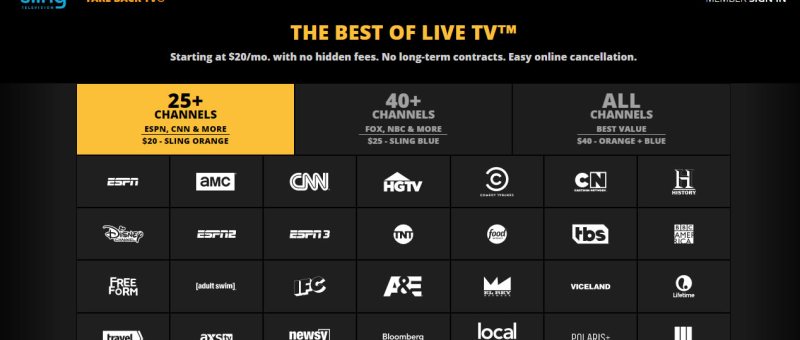
Sorting through which options or combination of options to sign up for—while keeping costs from spiraling—will be a headache. Dish’s basic $20 a month streaming package will get you ESPN, TNT and some cable channels but not broadcasters CBS, NBC and Fox. Apple wants to bring customers a “skinny bundle” including broadcasters and some cable channels but its service will cost more. Sony will soon offer something more akin to a full-on cable bundle, albeit likely at a higher price than the others—and notably, for now, without Walt Disney Co.’s ESPN and ABC.
On top of all this, consumers will have to factor in the cost of their broadband access. As a reference point, one operator charges $67 a month for a speed of 25 megabits per second once its first-year promotional discount ends.
Still, the new streaming world has the potential to be “better for many consumers” because it offers choice that the pay-TV industry never provided, said Roger Lynch, chief executive of Dish’s Sling TV streaming service. For the “vast majority of all consumers, the pay-TV bundle offers good value. But there’s a growing number of consumers for whom that doesn’t work anymore,” he said.
Media giants have their own calculations to make—quickly—as they prepare for a world that will look very different in 12 months than it has for the past several decades.
For years, TV channel owners and their pay-TV distributors—cable and satellite providers—were able to count on two reliable trends: that pay-TV subscriptions in America would grow each year, and that consumers would submit to paying ever-higher cable bills. In the past two decades, the pay-TV industry has grown by about 40 million subscribers to a total of about 100 million homes, and typical cable bills increased at a compound average annual growth rate of about 6.1%, according to the Federal Communications Commission. Those dynamics produced a steady stream of subscription revenue that drove profits for Disney and Viacom Inc. just as they did for Comcast Corp. and DirecTV.
But evidence mounted over the past couple of years that something fundamental was changing. In 2013, the industry’s base of subscribers contracted for the first time. Last year, pay-TV subscriptions fell by 129,000 industrywide, according to MoffettNathanson, even as analysts said new household formation surged, typically a good sign for the industry in years past.
And besides cutting the cord, more consumers started “shaving” it, downgrading to cheaper packages that operators began to offer. Comcast, for instance, offers an “Internet Plus” package of HBO, fast broadband and local channels for $40 a month, and AT&T has been peddling a similar $49-a-month bundle that also includes Amazon.com Inc.’s Prime free-shipping and streaming-video service for a year.
A mutiny was afoot, threatening the pay-TV fortress. “The ice cube is melting,” one senior industry executive said. “It’s a reality of the marketplace.”
The TV advertising business got a shock as ratings for major cable channels plunged, particularly over the second half of last year. The Cabletelevision Advertising Bureau, an industry trade group, recently told media executives that it estimates 40% of the ratings decline was due to viewers migrating from traditional television to subscription streaming services like Netflix.
“It was happening at a pace no one was anticipating,” said an executive at one big TV network. “We said, ‘We better start finding other ways to grow.’ ”
And with that, media companies that for years had pooh-poohed cord-cutting was a real threat, began to embrace it, albeit reluctantly. HBO, owned by Time Warner Inc., announced its stand-alone Web streaming service in October, followed by CBS, while in the background Dish and Sony assembled rights for their online TV bundles.
The goal for TV channels is to carry out this experimentation while safeguarding the traditional business to the extent possible. Virtually every TV network that has launched a Web TV service says it hopes to target the roughly 10 million homes that subscribe only to broadband service—without encouraging any current pay-TV subscribers to drop their service.
But holding on to pay-TV customers is getting harder. “We think there is going to be a continual dripping, dripping, dripping of millennial consumers and poor consumers who will be outside of the big bundle,” said MoffettNathanson analyst Michael Nathanson in an interview.
One risk of the media companies’ strategy is that by bringing TV channels to the Web they aren’t thinking far enough beyond their current business models. Their real competition for young audiences in coming years will come from companies like Facebook, Vimeo and Vessel that are attracting content creators from entirely outside the pay-TV ecosystem, said Mr. Nathanson and his fellow analyst Craig Moffett.
“Our suspicion is that the millennial cord cutter isn’t waiting around for just the right package of cable channels that only their parents watch,” they wrote in a research note Tuesday.
Not every TV channel is assured a secure place in the emerging Web TV world, analysts say. The small and midtier channel owners—companies like Discovery Communications Inc., Viacom, Scripps Network Interactive, and A+E Networks—will be jockeying to make sure their networks are in the online TV bundles being marketed to the audience of the future.
Some are making headway. Discovery, owner of Discovery Channel, Animal Planet and TLC, and Viacom, owner of MTV, Comedy Central and Nickelodeon, are in talks to be on the Apple service, people familiar with the matter said. Some A+E Networks channels will be added to Sling TV’s core package by the end of March, the companies announced Tuesday.
Read More at WSJ.com


 davidgriffith.blog