12 Big Trends Shaping the Future of Digital Advertising

Mary Meeker presented the most anticipated Powerpoint deck of the year at the annual Recode Code Conference last Wednesday. Below are the big trends she highlighted that will shape the future of digital advertising.

  1. Mobile Growth May Have Peaked
    2017 was the first year in which smartphone unit shipments didn’t grow at all. As more of the world become smartphone owners, growth has been harder and harder to come by. The same goes for internet user growth, which rose 7 percent in 2017, down from 12 percent the year before.
  2. Digital Time Spent is Increasing
    People, however, are still increasing the amount of time they spend online. U.S. adults spent 5.9 hours per day on digital media in 2017, up from 5.6 hours the year before. Time spent on mobile has reached 3.3 hours a day, which is more than double from 1.6 hours in 2012.
  3. Search is Evolving
    49 percent of product searches now start at Amazon—36 percent start on a search engine. What’s more, Amazon is better poised to capitalize on those searches with features like one-click purchasing, which encourage consumers to use Amazon to fulfill orders that result from those searches. Search engines and content sites do a better job of inspiring consumers to want things.
  4. The Lines are Blurring Between Ads, Products, Content & Transactions
    Online browsing is evolving into buying, fueled by social media. Facebook leads the way with 78 percent of survey respondents saying they have discovered products on the platform, followed by Instagram and Pinterest with 59 percent, Twitter with 34 percent and Snap with 22 percent. What’s more, 55 percent of respondents said they have purchased a product online after a social media discovery.
  5. Google is Shifting to E-commerce as Amazon Shifts to Search
    Google is expanding from an ads platform to a commerce platform via Google Home Ordering. Meanwhile, e-commerce giant Amazon is moving into advertising.
  6. Voice is Going Mainstream
    Voice-controlled products like Amazon Echo are taking off. The Echo’s installed base in the U.S. grew from 20 million in the third quarter of 2017 to more than 30 million in the fourth quarter.
  7. E-Commerce Growth is Accelerating
    E-commerce sales growth is continuing to accelerate. It grew 16 percent in the U.S. in 2017, up from 14 percent in 2016. Amazon is taking a bigger share of those sales at 28 percent last year. Conversely, physical retail sales are continuing to decline.
  8. Subscription Services Continue to Grow
    They’re seeing massive adoption, with Netflix up 25%, The New York Times up 43%, and Spotify up 48% year-over-year in 2017. A free tier helps to accelerate conversion rates.
  9. Data Driven Experiences Create a Privacy Paradox
    Advertising and usability improvements driven by data create what Meeker calls a privacy paradox: Advertising and services are made better thanks to user data, users engagement and value is increased, and regulators want to ensure user data is not used improperly. Technology-driven trends are changing so rapidly that it’s rare when one side fully understands the other, setting the stage for reactions that can have unintended consequences
  10. Print Media Continues to Decline
    Since 2011, the share of U.S. media consumption that happens in print has dropped about 40 percent. But the share of American ad dollars that go to print has dropped more than 60 percent.
  11. Disruption is Accelerating
    The speed of technological disruption is accelerating. It took about 80 years for Americans to adopt the dishwasher. The consumer internet became commonplace in less than a decade.
  12. Ai Will Continue to Evolve
    Internet leaders like Google and Amazon will offer more artificial intelligence service platforms as AI becomes a bigger part of enterprise and advertising spending.

Here are the slides:

Unbundling Pay-TV Brings New Challenges for Media


The media industry is racing toward an Internet-TV future at a breathtaking pace. But the swift changes, highlighted by efforts from Apple Inc., Dish Network Corp. and others, are giving consumers an array of confusing options and forcing entertainment giants to confront some sober realities.

Not long ago, consumers who wanted to watch “Monday Night Football” on ESPN, “Mad Men” on AMC or “Game of Thrones” on HBO knew what they had to do: shell out for a cable package that typically costs around $90 a month in the U.S. They could catch old seasons of popular shows on Netflix or a similar streaming on-demand service, but live, up-to-date programming lived in the cable bundle.

In the span of a few months, tectonic shifts are remaking a television landscape it took decades to sculpt, opening up a range of other possibilities for “cord cutters” who don’t want traditional pay TV. Apple is working on an Internet-TV service with some 25 channels, which is expected to be priced between $25 to $35 a month, according to people familiar with its plans. It will join Dish Network Corp. and Sony Corp., which are pitching their own online-TV bundles. A host of TV companies, including HBO, NBCUniversal, Nickelodeon’s Noggin and CBS, are in the mix with stand-alone streaming offerings.

But if consumers drop pay TV and sign up for TV services delivered over broadband, will they really get a better deal?

“If you buy retail and you have six or seven of these things, that might cost you as much as a bundle that gives you 400 different networks,” said Philippe Dauman, CEO of Viacom, which earns money from bundled channels but also recently launched a subscription streaming service aimed at preschool children that it imagines will be complementary to the bundle.

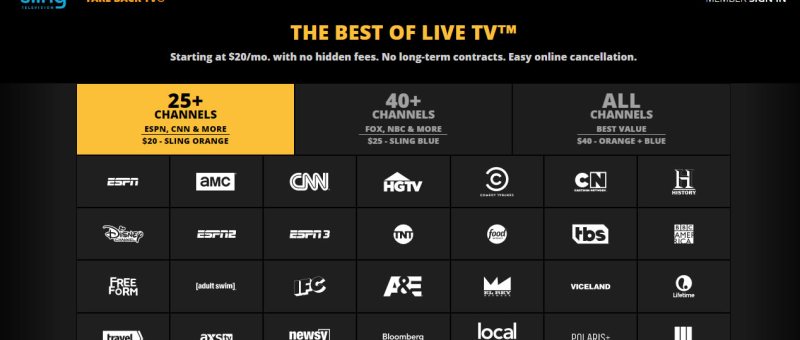
Sorting through which options or combination of options to sign up for—while keeping costs from spiraling—will be a headache. Dish’s basic $20 a month streaming package will get you ESPN, TNT and some cable channels but not broadcasters CBS, NBC and Fox. Apple wants to bring customers a “skinny bundle” including broadcasters and some cable channels but its service will cost more. Sony will soon offer something more akin to a full-on cable bundle, albeit likely at a higher price than the others—and notably, for now, without Walt Disney Co.’s ESPN and ABC.

On top of all this, consumers will have to factor in the cost of their broadband access. As a reference point, one operator charges $67 a month for a speed of 25 megabits per second once its first-year promotional discount ends.

Still, the new streaming world has the potential to be “better for many consumers” because it offers choice that the pay-TV industry never provided, said Roger Lynch, chief executive of Dish’s Sling TV streaming service. For the “vast majority of all consumers, the pay-TV bundle offers good value. But there’s a growing number of consumers for whom that doesn’t work anymore,” he said.

Media giants have their own calculations to make—quickly—as they prepare for a world that will look very different in 12 months than it has for the past several decades.

For years, TV channel owners and their pay-TV distributors—cable and satellite providers—were able to count on two reliable trends: that pay-TV subscriptions in America would grow each year, and that consumers would submit to paying ever-higher cable bills. In the past two decades, the pay-TV industry has grown by about 40 million subscribers to a total of about 100 million homes, and typical cable bills increased at a compound average annual growth rate of about 6.1%, according to the Federal Communications Commission. Those dynamics produced a steady stream of subscription revenue that drove profits for Disney and Viacom Inc. just as they did for Comcast Corp. and DirecTV.

But evidence mounted over the past couple of years that something fundamental was changing. In 2013, the industry’s base of subscribers contracted for the first time. Last year, pay-TV subscriptions fell by 129,000 industrywide, according to MoffettNathanson, even as analysts said new household formation surged, typically a good sign for the industry in years past.

And besides cutting the cord, more consumers started “shaving” it, downgrading to cheaper packages that operators began to offer. Comcast, for instance, offers an “Internet Plus” package of HBO, fast broadband and local channels for $40 a month, and AT&T has been peddling a similar $49-a-month bundle that also includes Amazon.com Inc.’s Prime free-shipping and streaming-video service for a year.

A mutiny was afoot, threatening the pay-TV fortress. “The ice cube is melting,” one senior industry executive said. “It’s a reality of the marketplace.”

The TV advertising business got a shock as ratings for major cable channels plunged, particularly over the second half of last year. The Cabletelevision Advertising Bureau, an industry trade group, recently told media executives that it estimates 40% of the ratings decline was due to viewers migrating from traditional television to subscription streaming services like Netflix.

“It was happening at a pace no one was anticipating,” said an executive at one big TV network. “We said, ‘We better start finding other ways to grow.’ ”

And with that, media companies that for years had pooh-poohed cord-cutting was a real threat, began to embrace it, albeit reluctantly. HBO, owned by Time Warner Inc., announced its stand-alone Web streaming service in October, followed by CBS, while in the background Dish and Sony assembled rights for their online TV bundles.

The goal for TV channels is to carry out this experimentation while safeguarding the traditional business to the extent possible. Virtually every TV network that has launched a Web TV service says it hopes to target the roughly 10 million homes that subscribe only to broadband service—without encouraging any current pay-TV subscribers to drop their service.

But holding on to pay-TV customers is getting harder. “We think there is going to be a continual dripping, dripping, dripping of millennial consumers and poor consumers who will be outside of the big bundle,” said MoffettNathanson analyst Michael Nathanson in an interview.

One risk of the media companies’ strategy is that by bringing TV channels to the Web they aren’t thinking far enough beyond their current business models. Their real competition for young audiences in coming years will come from companies like Facebook, Vimeo and Vessel that are attracting content creators from entirely outside the pay-TV ecosystem, said Mr. Nathanson and his fellow analyst Craig Moffett.

“Our suspicion is that the millennial cord cutter isn’t waiting around for just the right package of cable channels that only their parents watch,” they wrote in a research note Tuesday.

Not every TV channel is assured a secure place in the emerging Web TV world, analysts say. The small and midtier channel owners—companies like Discovery Communications Inc., Viacom, Scripps Network Interactive, and A+E Networks—will be jockeying to make sure their networks are in the online TV bundles being marketed to the audience of the future.

Some are making headway. Discovery, owner of Discovery Channel, Animal Planet and TLC, and Viacom, owner of MTV, Comedy Central and Nickelodeon, are in talks to be on the Apple service, people familiar with the matter said. Some A+E Networks channels will be added to Sling TV’s core package by the end of March, the companies announced Tuesday.

Read More at WSJ.com

Food Network Launches “Discover Food Network” Channel on SnapChat

https://www.youtube.com/watch?v=UbOMqA2AOIk

Popular messaging app Snapchat announced today that it has partnered with top media media brands, including Food Network, in order to launch a new in-app news feature that will allow users to access a collection of the day’s top stories and videos with just one swipe.

The app’s new ‘Discover’ feature includes 12 unique news channels, one for each media partner, plus a dedicated Snapchat channel which will include original content from the app’s creators.

With the move, Snapchat is positioning itself as a media platform — one that reaches an estimated 100-plus million monthly active users. Snapchat Discover will compete with other video platforms and services that encompass video, including YouTube, Facebook and Twitter. Every channel in Snapchat Discover is refreshed after 24 hours, “because what’s news today is history tomorrow,” the company explained.

Food Network is Snapchat’s exclusive launch partner within the food category. The Discover Food Network channel on Snapchat extends the Food Network brand to reach even more young consumers with new and exciting content tailored specifically for that audience. As well as being an engaging new channel for young food fans, Discover Food Network on Snapchat will provide a new opportunity for advertisers to reach engaged young people who love food.

“Food Network has led the dialogue around food for more than two decades, informing and entertaining passionate and engaged fans, and we are excited to bring it to the Snapchat platform,” says Brooke Johnson, President of Food Network & Cooking Channel. “Audiences are more food-conscious than ever before and the Discover Food Network channel on Snapchat will provide users with the great content they love, designed specifically for their mobile devices.”

Users can tap on a channel and swipe left to flip through each channel’s daily edition, containing five to ten stories selected for the service by the Food Network editorial team.

The expectation is that some consumers will discover Food Network content through Snapchat, then seek more through Food Network’s television channels, digital and mobile platforms.

Twitter to Expand Video Offering


According to Mashable, Twitter is developing a new video ad unit to support its soon-to-launch native video tool.

While details are still being hammered out, Twitter is apparently leaning toward a “pay-for-play” cost structure. It would include a six-second preview video that automatically plays in user feeds and the option to click to view the entire video.

Most likely, ads will only appear if and when users choose to view the full video, sources say.

“They don’t have it totally figured out yet,” said one marketing executive who was briefed on Twitter’s plans. Specifically, the microblogging giant has yet to decide exactly when advertisers would be charged for a video “view,” or its cost.

Key to new native tool will be a content discovery (or “surfacing”) feature, Kevin Weil, vice president, product at Twitter, said in November.

“We’re experimenting with better ways to give you what you come to Twitter for: a snapshot of what’s happening,” Weil explained in a blog post. “We can use information like who you follow and what you engage with to surface highlights of what you missed, and show those to you as soon as you log back in or come back to the app.”


Mobile Advertising expected to surpass desktop by 2017

Mobile advertising is growing so rapidly that it will pass desktop advertising by 2017, according to a new report from eMarketer.

Leading the way will be search ads; mobile accounts for 22% of all search ads this year and is expected to grow to 60% by 2017. It was at 2% only three years ago. About half of all spending on display ads will be in mobile’s column by 2017 as well. Other key findings:

Mobile search ads should be worth $4.34 billion this year, up from $3.95 billion in 2012.

Mobile display ads should bring in $3.81 billion in 2013, up from $3.38 billion last year.

Mobile ad dollars overall will more than double from last year to $8.5 billion.

Video-ad revenue on mobile and desktops is expected to hit $4.1 billion this year and rise to $9.2 billon in 2017.

Interpublic takes big step towards Programmatic TV buying

Interpublic Group, one of the largest media agency conglomerates, is taking a big leap toward automated buying in a development that could have a huge impact on the current media ecosystem.

According to the Wall Street Journal, Interpublic has begun building a new system that will allow it to automatically buy TV and radio ads and has partnered with Clear Channel, A&E Networks, Tribune Co. and Cablevision to test the new system.

The idea is to use existing technology to better target ad buys, and to get rid of some of the more cumbersome parts of making a TV ad buy, which can take weeks or months to iron out under the current system.

TV networks are cautious as there’s speculation that an automatic system could have an impact on media rates, as it has for online search display ads.

Im a firm believer that anything that can be sold programmatic, will eventually move to programmatic and Interpublic has just taken the first step.

Programmatic Buying makes a play for TV

Programmatic buying is a hot topic in the digital media world, but recently a new “audience-buying” platform called AudienceXpress has been making the headlines on Madison Avenue as it rolls out an automated system enabling agencies and their trading desks to serve ads into the most premium network television inventory.

Because of its implications for the overall media marketplace, the rapid rise of programmatic trading in online display advertising has been one of the most closely watched developments of the past couple of years, splitting Madison Avenue and its media supply chain into two philosophical camps: Those that want to preserve the world of old-school media-buying based on relationships and person-to-person negotiations; and those who want to shift to a new world of “audience-buying” based on scientific, real-time, transparent programmatic technology enabling brands to reach the audiences they are seeking with their precision at that exact moment they need to reach them.

The fear of losing control over the value of advertising inventory has been the major impediment to programmatic exchanges in the online business, but that hasn’t stopped the online display market from developing a marketplace based on sell-side machines trading with buy-side ones.

While supply was a big factor in the success of programmatic trading online, other big factors including the needs for agencies to improve their margins by utilizing technology to automate the way they buy in an increasingly fragmented media marketplace, as well as their philosophical shift from old school “media-buying” based on the seller’s inventory to the new world of “audience-buying” based on reaching the consumers that their clients’ brands want to reach with their ad messages.

According to the most recent estimates from Interpublic’s Magna unit, programmatic buying of media currently represents about 25% of online display buys, and is growing fast.

Since it went live in January with a beta being used by the trading desks of at least two of the biggest agency holding companies, AudienceXpress has already served nearly 2 billion ad impressions to network TV viewers nationwide — all below the radar of most of the TV advertising industry

One of the first adopters of AudienceXpress are cable operators because the platform gives them an incredibly efficient means of selling their TV advertising inventory to national advertisers in a way that does not cannibalize on the local and regional buys sold by their direct, in-house sales organizations.

The system essentially enables local cable operators to efficiently and automatically pool the local TV advertising avails they split with their cable network partners into an audience trading platform that taps the budgets of national advertisers. In other words, it enables local cable TV operators to compete directly for ad budgets with the national advertising sales organizations of their network affiliates. Generally, national cable TV networks give two minutes per hour to cable systems to sell as part of their distribution agreements.

Programmatic trading has quickly matured on Madison Avenue, and every major agency now has its own trading desk, or works with an array of independents. Almost all of them claim to be either currently buying or close to developing a solution for buying TV advertising inventory through their systems. At least two are doing so already.

In the minds of most TV folks, real-time bidding means devaluing your inventory, The AudienceXpress value proposition is to provide liquidity — largely for the sell-side — by applying
technology on the back-end and the front end, and then layering on audience data that increases the value of that inventory to advertisers.

Cable well positioned for TV Ad Market

Broadcast-television ratings have dropped sharply this season. That, combined with the weak economy and competition from digital media, indicate a bad season for the spring TV ad-sales market, ad buyers and analysts say.

Some of them are predicting that the broadcast networks’ take will be steady to slightly lower in this years upfront,  in which TV executives pitch their new shows for the coming season.

More TV ad dollars are expected to move to cable channels, a shift that has accelerated in the past couple of years. But both broadcast and cable television are facing more intense competition from online media, including Web video outlets.

The ratings declines have some marketers rethinking their ad-buying strategies, ad buyers said. Some are expected to shift money to cable channels, they said. While ratings have declined at some cable channels, ad prices on cable tend to be lower than on broadcast TV, according to ad buyers.

In some cases, the Web could take a share of those dollars. “Advertisers have seen a significant shortage of ratings, and some are willing to take some money and move it online,” said John Muszynski, chief investment officer at ad company Publicis Groupe

Publicis’s ZenithOptimedia expects TV advertising to grow just 2.8% this year to $63.9 billion. Zenith expects outlays on network-TV ads to decline 2% and spending on cable to increase 7%

Full Story at WSJ.com

Multi-screen marketing requires a new marketing approach

Now more than ever, consumers want content at their fingertips and they can obtain it across multiple screen platforms whether it’s by a television, computer, tablet or mobile phone.

The use of non-screen media has declined by 22% since 2008 while television, computer internet and mobile have increased by one hour and twenty minutes during the same time frame.

Consumers have also become more efficient in multitasking since they can retrieve information various ways. About 40% of consumers use their smart phones or tablets while watching TV.

Video advertisers in the past had only one screen to target: the television. However, the rise of computers and mobile devices has boosted video viewing consumption across devices.

Yet, while the TV is no longer the sole video option for consumers, no single alternative has replaced television as the clear top choice for media consumption. According to a new report from ad network YuMe, 49 percent of all media consumption still comes from a television, 16 percent from the internet.

In addition, the report found that the average American owns close to four devices, and total figures show that there are more than 37 million tablets, more than 86 million PCs and close to 287 million TV sets owned in the United States.

So while the television is still the dominant media consumption option for many Americans, the proliferation of internet-enabled devices has cut into TV’s lead. As a result, consumers see video ads more than ever, which can make one spot appearing on only a TV or a computer less effective. YuMe’s report found that TV ads were only recalled about 27 percent of the time. In comparison internet video ads were remembered 43 percent of the time and mobile video ads had a 35 percent recall rate.

While the proliferation of smartphones, tablets and PCs may seem like it would hurt brands, but the key, is to think outside of traditional siloed efforts and focus on a new approach that reaches consumers across screens.

While TV is still the dominant platform for video, we are rapidly moving from a 100m+ household TV market to a billion+ screen based market. Now is the time for marketers to start thinking differently.

New Report highlights online video growth

FreeWheel has released a new report that highlights video viewership trends in 2012, based on aggregated data from the company’s entertainment clients, including FOX, ESPN, VEVO, and AOL, among others. The company says its findings are derived from more than 13.5 billion video ad views. Among the major findings:

Web video ads are becoming more like TV spots: In 2012, the standard 30-second TV spot became the most used format on the web (42% of all digital video ads). This is at the expense of 15-second spots, which now account for 34% of video ads.

Ad volume continues to grow: Q4 video ad volume rose 47% year-over-year, fueled largely by holiday spending and increased ad loads. In fact, web videos of 20+ minutes now have 9.4 video ads per video view, which FreeWheel says is the most since it began reporting this data in 2010, and up from 6.9 per video view during Q4 2011. Q4 pre-roll volume increased 45% year-over-year and Q4 mid-roll volume jumped up 60%.

Video ad completion rates are at an all-time high: 93% for long-form content (20+ minutes); 81% for mid-form content (5-20 minutes); and 68% for short-form content (less than 5 minutes).

Video viewing on non-PC/Macs is growing, and iOS is leading the charge: In Q4 2011, viewing on devices like smartphones, tablets, and gaming consoles accounted for 2% of total video viewing volume. By Q4 2012, that number is up to 12%. More than 1.8 billion video views occurred on these devices in Q4 2012. Apple devices continue to dominate, with iOS devices accounting for 60% of non-PC/Mac video viewing. Android devices represent 32% of such video viewing.