
Can Social TV Save Live Televison?

For decades, technology has chipped away at TV. VCRs, streaming Internet video, file sharing, DVRs, on-demand cable and mobile video provided TV alternatives, decreased TV’s audience, increased time shifting or encouraged ad skipping. One of the intriguing things about social media is that it is the first technological advance that really benefits TV without specifically being about TV.

Of course, television was social before we had social media. TV shows drove “water cooler” chatter since Lucy Ricardo gave birth to “Little Ricky” – 71.7% of all American TV sets were tuned to “I Love Lucy” the night Lucille Ball’s character gave birth in 1953. Crowdsourcing is not new to television, either; letter writing campaigns to save TV shows date back to at least 1968 when fans got NBC to renew “Star Trek” for another season. The fact TV viewing is innately social makes it the perfect match for today’s social media and mobile technology.

With the real-time sharing that happens via social media, it once again seems exciting and necessary to watch live TV. No one wants to see spoilers of their favorite shows–a recent TV Guide study found that 27 percent of us are watching more live TV to avoid plot and reality spoilers revealed on social networks. People may hate them, but don’t expect TV networks to make it any easier for you to avoid those spoilers; hashtags are popping up in the corner of TV screens to encourage viewers to join the dialog on Twitter. According to Chloe Sladden, Twitter’s director of content and programming, those perpetual hashtags can at least double the amount of activity and could drive as much as 10 times the tweets.

The power of real-time social media to drive TV viewership was demonstrated last year when Charlie Sheen made an 11th-hour appearance on CNN’s “Piers Morgan Tonight.” Though the show had almost no advance promotion, social networks lit up once the interview began, and 45 minutes into the show, viewership in the 25-to-54 demo was up 61%.

Networks are also encouraging real-time social media engagement with their shows by making stars and reality TV contestants available to fans. The competitors on The Voice are encouraged to tweet and connect with their fans, quite a change from when American Idol prevented contestants from having active Myspace pages or Twitter accounts. In addition, more and more networks are increasingly featuring stars in Twitter chats while their shows are broadcast.
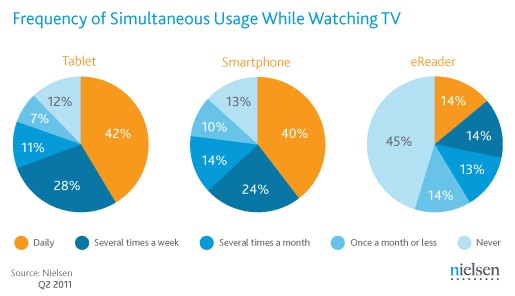
The growth of mobile technology is powering multitasking and sharing while watching TV. According to Elizabeth Shaw’s recent Forrester report, almost two-thirds of Gen X and three-quarters of Gen Y consumers go online while watching television. Further evidence comes from Nielsen, which found that 88 percent of tablet owners and 86 percent of smartphone owners used their devices while watching TV at least once during a 30-day period. It turns out this behavior is extremely common–roughly two-thirds of these folks use their device while watching television at least several times a week.
Today’s Social TV is being powered by more than just Twitter and Facebook; new sites and tools such as GetGlue are focused on increasing social engagement around live TV. GetGlue only has 2 million users, but it has already driven 100 million check-ins (although entertainment check-ins have a long way to go to catch Foursquare’s 2 billion location check-ins.) Many other tools, including some created by the networks themselves, seek to drive more Social TV activity. Other sites and apps include MTVWatchWithNBC Live, IntoNow, Miso and show-specific apps such those for Bones, Celebrity Apprentice and New Girl.

Between GetGlue, Twitter, Facebook, blogs and boards, lots of us are talking about TV, and this is not just common among teens; in fact, according to Nielsen, people who talk about TV shows online skew older. The 25- to 34-year-old demographic accounts for just 17 percent of the overall social media population but is responsible for 29 percent of those on sites talking about TV.

All the check-ins, tweets and posts are having an effect. TV Guide’s study found that 17 percent of respondents say they have started to watch a show and 31 percent say they have continued to watch a show because of a social impression.

Another study by NM Incite, a Nielsen/McKinsey Company, found a complex relationship between social media buzz and TV ratings. Buzz most closely correlated with increased TV viewership in consumers aged 18 to 34; in this demographic, a 9% increase in buzz volume around the time a show premiered correlated to a 1% increase in ratings, but as the season wore on, the relationship between the two variables weakened. However, with older viewers, social buzz had a greater impact on ratings toward the end of the season than at the beginning or middle.

In addition to driving attention and viewership in shows, TV networks are also using social media data to tweak their shows to be more appealing to viewers. The producers of the 2010 MTV Video Music Awards focused more attention on Lady Gaga after her meat dress became a trending topic on Twitter. Simon Cowell, who once criticized celebrities on Twitter by asking, “Why would you want to talk to people like that?”, now uses audience feedback from Twitter to influence the format of The X Factor and tweets regularly at @simoncowell. New services such as Trendrr.TV are giving networks reams of data to measure viewer affinity not just for shows but also for granular attributes such as plotlines and characters.

The opportunities in Social TV will only continue to grow as more case studies demonstrate success. The 2012 Video Music Awards (VMAs) is one such success story. MTV pushed the #VMA hashtag using a Promoted Trend and on-screen text during the broadcast. It also hosted an online “Twitter Tracker” site during the award ceremony and displayed the results during commercial breaks to attendees in the theater to encourage their participation online. MTV’s microsite even featured a seating chart of the theater to see the spots from which celebrities were tweeting.

The social promotion effort worked. Twitter saw over 10 million VMA Tweets, and the Promoted Trend had a 16% engagement rate, driving 27 times the average mentions of MTV’s Twitter account and adding 128,000 new followers to MTV’s Twitter account on the day of the event. The social media activity contributed to the success of the 2012 VMAs broadcast–it was the largest audience ever for any telecast in MTV’s history.

TV Everywhere Finally Becomes a Reality

NimbleTV.com has announced a game changing new subscription-based TV platform that enables customers to access their television from anywhere in the world, on any device.

Customers can access their subscription TV service using NimbleTV cloud-based software that lets them view their TV wherever they are – with nearly unlimited recording capability and social tools to help guide what to watch. The service is a global platform beginning with TV offerings from the U.S. and India, and will roll out to other countries.

“NimbleTV is based on the simplest idea: customers should be able to access the TV they pay for wherever they happen to be,” said CEO Subramanian. “Today, the groundbreaking technology behind our service makes ‘TV everywhere’ a reality – with more options, high-quality viewing on any device, watchable from anywhere. Our model is predicated on the belief that providers and content producers should be paid. NimbleTV is a solution that’s both consumer friendly and industry friendly.”

NimbleTV sets customers up with their own subscription agreements with TV providers that NimbleTV supports. Customers make payments directly to their providers with NimbleTV acting as a payment service. In addition to local coverage, NimbleTV includes all cable channels, depending on which package a customer selects. The service has more than 10,000 hours of digital recording. There is no box to buy or equipment to set up. NimbleTV has built-in social features that enable customers to easily follow and record what their friends like to watch on TV.

Digital Video Advertising Hits New Record

According to comScore’s latest online video numbers 181 million people watched over 36 billion online videos in March 2012. The leaderboard on this front was comprised of the usual suspects: Google/YouTube, Yahoo!, VEVO, Facebook and Viacom Digital ranked at the top in terms of unique viewers, while Google/YouTube and Hulu remained the kings of online video in terms of average minutes per viewer.

On the video ad front, Americans watched more than 8.37 billion online video ads, a new record, with Hulu delivering more than 1.75 billion video ad views on its own, which is also a new record. Google slotted in at second with nearly 1.27 billion video ads during March, followed by BrightRoll Video Network (953 million), Adap.tv (892 million) and Specific Media (775 million). Other interesting findings from the report include:

83.5% of the U.S. internet audience viewed online video.

The duration of the average online video was 6.4 minutes, while the average online video ad was 0.4 minutes.

Video ads represented 18.5% of all video ads viewed, and 1.5% of all minutes spent viewing online video content.

Online Advertising Reaches New High in 2011

According to the new IAB Internet Advertising Revenue Report online ad revenues reached a record high of $31 billion in 2011, a 22% increase over 2010, which had also broken records with $26 billion in revenue. Highlights of the report include:

Mobile was the top category in terms of fastest growth, up 149% to $1.6 billion in 2011.

Digital video witnessed a 29% increase year-over-year, generating $1.8 billion in revenue last year.

Search remained top dog: 2011 revenues totaled $14.8 billion (+27%).

Display-related ad revenues in 2011 stood at $11.1 billion (+15%), carving out a 35% slice of total internet ad revenues.

Multiscreen Viewing Driven by Consumer Interest

While traditional ‘lean-back’ TV may be strong among U.S. viewers, a growing number of consumers have interest in — or have already adopted — multiscreen smaller device habits.
A new 2012 survey found that 57% of people are interested in multiscreen video services, up from 48% in 2011. The study comes from Toronto-based QuickPlay Media, a provider of video to IP-connected devices.

Another 35% have reported trying a mobile TV and/or video service, with 27% saying they currently use new video services. 43% of current users consume mobile TV and video at least once per week; and 23% have daily usage.

Much of this activity is relatively new: 72% have been mobile TV and video users for a year or less, and 81% say they watch more video on multiscreen devices than a year ago.

But not all advertising messaging is making an impact. Only 20% recall viewing ads on their device while using a mobile TV and/or video service, and 81% say there is a lack of advertising variety.

Good news for social media services: 74% are interested in viewing mobile TV and/or video channels that integrate sites such as Facebook or Twitter.

The big preference for specific programming is for TV episodes — which tallied a 38% score. Sports was next at 28%, followed by news at 19%. Live programming scored well — preferred by 51% of users — with a 30% score for sports, 21% for TV episodes, and 34% preferring an on-demand format.

Increasing Streaming Video Options Drive Consumer Confusion

Competing online video services have become so successful that about one-third of Americans have streamed a movie or TV show on Netflix, Hulu, Vudu, Crackle or another Net-based video service, according to Nielsen.

Americans will watch 3.4 billion movies online this year, more than doubling 2011’s total and exceeding DVD and Blu-ray consumption for the first time, estimates researcher IHS Screen Digest.

“We are looking at the beginning of the end of the age of movies” on discs, says IHS senior principal analyst Dan Cryan.

Another sign of streaming’s success is that entrenched pay-TV providers, such as Comcast, are creating their own similar services in an effort to keep subscribers.

That has resulted in a battle royal as traditional and upstart video services alike attempt to trump each other in hopes of swiping and keeping customers. With hardware makers and even large retailers such as Walmart also drooling for a piece of the programming pie, “It is confusing the hell out of people,” says Phil Swann, editor of TVPredictions.com.

Like it or not, TV lovers such as Larry R. Haynes are caught in a tug of war over the future of television. Haynes and his wife, Jennifer, subscribe to Comcast for Internet and TV, but they have trimmed their bill by canceling Showtime, while keeping HBO. And like many others, they have turned to Netflix for additional viewing options.

Streaming services “just do not have the selection like the cable companies do yet,” says the 32-year-old Grand Rapids, Mich., engineer. “So I am not about to cancel my cable service … like I hear a lot of people are doing.”

He has also experimented with Comcast’s smartphone app, which lets him watch streamed TV shows and movies. “It’s about time they started trying to retain their current customers,” he says.

That is music to the ears of cable companies as well as satellite services DirecTV and Dish Network and fiber-based networks Verizon FiOS and AT&T U-verse.

During the height of the economic downturn (2008-2011), more than 2.65 million subscribers — mostly cable subscribers — dropped their pay-TV service entirely in favor of streaming video options, according to The Convergence Consulting Group.

But satellite and broadband companies actually saw increases in subscribers.

And now that cable companies are fighting back with their own free and paid on-demand options, the rate at which subscribers are dropping cable may be starting to slow.

Get ready to be confused

Consumers increasingly will find themselves wading through multiple device options and payment plans for streaming services. “It’s going to be a bit complicated for a while,” says Maryann Baldwin of Magid Media Futures.

Netflix has been the key catalyst in the surge of streaming. The movie-rental superpower has grown its streaming service into a programming channel used by nearly 22 million of its 24.4 million subscribers.

Along with Hulu, Vudu and Crackle, Amazon’s Prime — which began as a two-day shipping service — has also become a formidable Netflix competitor. Prime costs $79 a year to join and allows free streaming of about 17,000 video titles, says Bill Carr, Amazon’s vice president of videos and music.

The all-you-can-stream subscription model helped win skeptical customers. The number of people who subscribe to an online streaming service grew 74% in 2011, IHS says.

“If you buy a movie, you sit through it even if it’s rubbish,” Cryan says. “With streaming, people just start a new” movie.

Even some content providers, such as HBO and a consortium of movie studios — via the cloud-based UltraViolet locker system — are developing their own delivery software.

Competition has been a boon for customers looking for the cheapest way to watch new films, such as Moneyball, or more obscure and high-definition choices.

“Now anybody with good content can reach an audience,” says Colin Dixon, analyst at The Diffusion Group. ”

So it’s not surprising that much of the marketing fight is about who has the best content, now that studios have made licensing easier. “But with so many streaming companies eager to get their hands on content, the licenses for new and popular titles are becoming more expensive for all,” Cryan says.

Netflix is hoping to stand out with originally produced shows. Last month, the service launched Lilyhammer, a series featuring E Street Band member Steven Van Zandt. Also in the works is House of Cards, starring Kevin Spacey. Netflix will also revive the Fox TV series Arrested Development next year.

“Eighteen months ago, Netflix said its strength is its breadth of library. (Others) now also have a lot of titles,” says Dan Rayburn, an analyst at StreamingMedia.com. “Netflix changed their tune to say it’s about exclusive content.” But he’s not sold on Netflix’s original content plans, noting the high rate of churn among its subscribers. “Producing something like Mad Men can cost $100 million.”

YouTube, which Nielsen says accounted for 45% of Americans’ online video streaming time in the fourth quarter of 2011, has its own TV channels, too.

Pay-TV strategies

With the battle for consumers’ eyeballs expanding to tablets and smartphones, pay-TV providers are making a stand.

TV watchers generally prefer to watch movies and TV shows from one interface, says Gerry Kaufhold, research director of digital entertainment at DisplaySearch/In-Stat. “The pay-TV services are all scrambling to come up with ways to put apps on tablets and smartphones so that they can provide that.”

•Comcast. Its Xfinity Streampix service gives its video subscribers on-demand viewing of movies and TV shows on iPhones and iPads.

Customers streamed about 375 million times per month at the beginning of the year — up from 325 million a year ago — across all categories. “There is a huge amount of engagement,” says Marcien Jenckes, Comcast Cable’s senior vice president of video services.

•Cox Communications. Last May, it introduced Cox TV Online, which gives customers access to 10,000 videos for computers and laptops. It’s already attracting 1 million views per month, says Steve Necessary, vice president of video strategy.

Cox also rolled out Cox TV Connect, an iPad app for more recent shows that can only be surfed at home by its customers. Released in December, the app is used by about 20% of Cox customers who own an iPad on a monthly basis.

•Dish Network. It upgraded its Blockbuster Movie Pass ($10 per month in addition to a Dish subscription) by adding instant streaming of more than 100,000 movies, TV shows and games to TV and iPad.

•Verizon. The telecom giant is creating a streaming service with Redbox, the DVD and Blu-ray disc rental kiosk company.

Pay-TV companies will fight to keep their customers within their product systems, and the perception that hordes of customers will cut the cord and flock to online streaming options is still premature, says Wedbush Securities analyst Michael Pachter.

Traditional TV providers remain the favorites of Hollywood and content owners, he says, because “they all lose if everything moves à la carte via the Internet.” Content owners and studios stand to make more from cable and satellite companies that already package channels and could easily add streaming features than from a model where subscribers paid for only the channels they wanted, he says.

To that end, Netflix CEO Reed Hastings has said that he is discussing with cable operators the bundling of its streaming service into pay-TV packages. “They would have to share some of the revenue with the cable operator, but that would make Netflix’s content instantly available for a cable subscriber,” Kaufhold says. “There’s no reason why that can’t happen.”

That type of the mash-up of traditional pay-TV offerings with Net app-based content, or hybrid TV service, will be in about 10 million U.S. homes by the end of 2012 and 35 million by 2016, In-Stat estimates. “The cable operators and the other pay-TV services are all moving in that direction,” Kaufhold says.

In the interim, all the streaming services are cozying up to video game hardware makers. Last week, Sony’s PlayStation 3 became the first video game console to provide access to Amazon.com’s Instant Video service, which has more than 120,000 movies and TV programs that you can buy or rent.

And Microsoft’s Xbox 360 has added apps to make it easier for Verizon, Comcast and HBO subscribers to view content through Xbox Live. “They see a great opportunity to use our platform to better serve their customers,” says Ross Honey, general manager of Xbox Live entertainment and advertising.

There also are so many dedicated streaming devices, such as Roku, Boxee and WD TV (by Western Digital), that some may not survive. “A couple of these guys are going to have a hard time standing alone,” Rayburn says. With a dizzying set of options that are constantly evolving, consumers will likely flock to the providers that keep things simple to use, he says.

“If you know what you’re doing, there are plenty of options. The problem is most consumers don’t,” he says. “There will be more fragmentation in two years. It’s a nightmare.”

from USA Today

Android Leads U.S. Smart Phone Marketshare

comScore’s MobiLens service has released its latest report on key trends in the U.S. mobile phone industry, this one covering the three-month average period ending in February 2012.

According to the report, Google’s Android crossed the 50% mark to capture a majority share of the U.S. smartphone market for the first time in its history (it accounted for a 46.9% share during the three-month average ending in November 2011). Apple and its iPhone line captured 30.2% of the smartphone market (+1.5%), while RIM, Microsoft and Symbian rounded out the top five in that order.

All together, comScore finds that 104 million people in the U.S. owned smartphones during the three months ending in February, which is up 14% versus November. In terms of mobile content usage:

49.5% of U.S. mobile subscribers used downloaded apps (+4.6%).

49.2% used a browser (+4.8%).

36.1% accessed a social networking site or blog (+3.1%)

32.3% played games (+2.6%).

The top dog was still text messaging, which jumped from 72.6% to 74.8%.

The Future of Shazam is TV

Shazam is one of the most popular smartphone apps of all time. Most people know it as that  interesting app that “listens” to a song and identifies the name of it, but what’s more interesting is Shazam’s increasing focus on television.

Since early 2010, Shazam has been gradually implementing and trialling TV-focused content in its app. The company is aiming squarely at the lucrative second screen app market. These are smartphone or tablet apps that interact with your television, as a “second screen” to navigate extra content for TV shows.

How Shazam For TV Works
When you see the Shazam logo pop up on a TV program (see screenshot above), you can open the Shazam app on your smartphone and access extra content. The latest TV show that Shazam has “enabled” for this extra content is Covert Affairs, on the USA network. The content available through the Shazam app includes episode information and video, character details and a Florence & The Machine song that featured in an episode.

Much of the TV functionality in Shazam relies on “calls to action” from within the media itself – in the form of the Shazam logo popping up on your TV screen. That’s a little different to how you use Shazam for music, where you explicitly launch the app to discover song titles. However, in both music and TV, Shazam is leading you to discover extra content.

The problem Shazam has faced over the years is that it’s been difficult to generate revenue off the extra content it offers around music. TV offers a potentially much greater revenue platform for Shazam, because they can partner with TV networks and – more significantly – TV advertisers.


Shazam’s evolution into TV programming

Live TV events are a prime market for the new Shazam. It partnered with a number of brands who advertised on TV coverage of the 2012 Super Bowl and the 2012 Grammy Awards Show. Indeed, more than a third of Super Bowl ads were Shazam enabled.

Shazam has shown impressive growth since its launch in 2008. Currently Shazam has over 200 million users now and is adding 1.5 million new users every week. From this increasingly large user base, Shazam is getting 6 million tags a day.

How Shazam Compares
According to statistics Shazam compiled, tagging a TV show with Shazam compares favorably with activity on Twitter and Facebook during the day the show airs. In the chart below, Shazam compares its tags with tweets and Facebook likes.

Shazam believes that tweets and check-ins (from apps like GetGlue and Miso) are not compelling enough for users. Twitter and the check-in apps would argue that the social activity they provide around TV programming is more than enough value-add. Shazam is betting that the media content it provides has even more value. Time will tell – right now there seems plenty of room for both approaches to second screen apps.

Smartphones now outnumber dumb phones

Smartphone owners in the U.S. now outnumber their fellow Americans that own a mobile phone that isn’t a smartphone, according to new data from Pew Research. 46% of Americans own a smartphone as of February 2012, marking an 11% jump from the 35% who reported owning such a device in May 2011; meanwhile, only 41% of Americans own a mobile phone that is not a smartphone.

Mobile Video Experiencing Explosive Growth

Mobile video advertising is experiencing “explosive” growth according to Rhythm NewMedia’s Insights Report for the fourth quarter of 2011, which found that 93% of advertising campaigns with Rhythm in Q4 included some form of video advertising.

The report also noticed a trend that consumers seem to respond better to ads during the holiday season; Video ads featuring seasonal creative had a 92.1% completion rate, while engagement with full-page ads and banners jumped 33% and 10%, respectively, over Black Friday and Cyber Monday.

Among the other data in the report, Rhythm found that in-stream mobile video ads saw an 89.1% completion rate, outperforming its online counterpart, with completion rates being high for 15-second (89.2%) and 30-second ads (88.3%) within premium content.

Taking a look at in-stream advertising within the two preeminent mobile operating systems, the completion rate for Android (92%) was slightly above that of iOS (87%).