New 5G Services Could Accelerate Cord Cutting in 2019

The rate of consumers dropping their cable and satellite TV packages hit the highest level ever in the fourth quarter of 2017, while Internet TV subscribership grew strongly.

According to analysts at Moffett Nathanson Research, the total number of pay-TV subscribers in Q4 dropped 3.4% from a year earlier, the highest rate of decline since the trend of cord cutting emerged in 2010, with almost 500,000 customers leaving in the fourth quarter alone, that leaves the industry with about 83 million cable households.

These calculations don’t include the growing number of households that never subscribed to a pay TV service in the first place, AKA: “Cord Nevers”. Over half of cord nevers are millennials, ages 18 to 34, but just 35 percent of cord cutters are millennials.

The cable bundle has become increasingly unappealing as consumers have turned to more flexible and less expensive video offerings, disrupting the traditional cable TV model, like Netflix and Hulu that feature traditional TV and movie formats, to shorter programming from YouTube, Facebook, and Snapchat.

But offsetting the shift is the growing number of people signing up for packages of TV channels delivered over the Internet by services like Google’s YouTube TV, Dish Network’s Sling TV and AT&T’s DirecTV Now. At about $20 to $50 per month, the online offerings are considerably cheaper than the average cable TV bundle.

Later this year Verizon, T-Mobile, and AT&T will all be launching 5G networks creating real competition among home internet services. Instead of having one or two options to choose from, consumers will have 5 or more broadband services options, driving a new wave of cord-cutting as consumers continue to unbundle internet services from their local cable company.

12 Big Trends Shaping the Future of Digital Advertising

Mary Meeker presented the most anticipated Powerpoint deck of the year at the annual Recode Code Conference last Wednesday. Below are the big trends she highlighted that will shape the future of digital advertising.

  1. Mobile Growth May Have Peaked
    2017 was the first year in which smartphone unit shipments didn’t grow at all. As more of the world become smartphone owners, growth has been harder and harder to come by. The same goes for internet user growth, which rose 7 percent in 2017, down from 12 percent the year before.
  2. Digital Time Spent is Increasing
    People, however, are still increasing the amount of time they spend online. U.S. adults spent 5.9 hours per day on digital media in 2017, up from 5.6 hours the year before. Time spent on mobile has reached 3.3 hours a day, which is more than double from 1.6 hours in 2012.
  3. Search is Evolving
    49 percent of product searches now start at Amazon—36 percent start on a search engine. What’s more, Amazon is better poised to capitalize on those searches with features like one-click purchasing, which encourage consumers to use Amazon to fulfill orders that result from those searches. Search engines and content sites do a better job of inspiring consumers to want things.
  4. The Lines are Blurring Between Ads, Products, Content & Transactions
    Online browsing is evolving into buying, fueled by social media. Facebook leads the way with 78 percent of survey respondents saying they have discovered products on the platform, followed by Instagram and Pinterest with 59 percent, Twitter with 34 percent and Snap with 22 percent. What’s more, 55 percent of respondents said they have purchased a product online after a social media discovery.
  5. Google is Shifting to E-commerce as Amazon Shifts to Search
    Google is expanding from an ads platform to a commerce platform via Google Home Ordering. Meanwhile, e-commerce giant Amazon is moving into advertising.
  6. Voice is Going Mainstream
    Voice-controlled products like Amazon Echo are taking off. The Echo’s installed base in the U.S. grew from 20 million in the third quarter of 2017 to more than 30 million in the fourth quarter.
  7. E-Commerce Growth is Accelerating
    E-commerce sales growth is continuing to accelerate. It grew 16 percent in the U.S. in 2017, up from 14 percent in 2016. Amazon is taking a bigger share of those sales at 28 percent last year. Conversely, physical retail sales are continuing to decline.
  8. Subscription Services Continue to Grow
    They’re seeing massive adoption, with Netflix up 25%, The New York Times up 43%, and Spotify up 48% year-over-year in 2017. A free tier helps to accelerate conversion rates.
  9. Data Driven Experiences Create a Privacy Paradox
    Advertising and usability improvements driven by data create what Meeker calls a privacy paradox: Advertising and services are made better thanks to user data, users engagement and value is increased, and regulators want to ensure user data is not used improperly. Technology-driven trends are changing so rapidly that it’s rare when one side fully understands the other, setting the stage for reactions that can have unintended consequences
  10. Print Media Continues to Decline
    Since 2011, the share of U.S. media consumption that happens in print has dropped about 40 percent. But the share of American ad dollars that go to print has dropped more than 60 percent.
  11. Disruption is Accelerating
    The speed of technological disruption is accelerating. It took about 80 years for Americans to adopt the dishwasher. The consumer internet became commonplace in less than a decade.
  12. Ai Will Continue to Evolve
    Internet leaders like Google and Amazon will offer more artificial intelligence service platforms as AI becomes a bigger part of enterprise and advertising spending.

Here are the slides:

The Amazon Machine

When you look at large manufacturing companies, it becomes very clear that the machine that makes the machine is just as important as the machine itself. There’s a lot of work in the iPhone, but there’s also a lot of work in the machine that can manufacture over 200m iPhones in a year. Equally, there’s a lot of work in a Tesla Model 3, but Tesla has yet to build a machine that can manufacture Model 3s efficiently, reliable, quickly and at quality at the scale of the incumbent car industry.

More than any of the other big tech platform companies, Amazon is a machine that makes the machine. People tend to talk about the famous virtuous circle diagram – more volume, lower costs, lower prices, more customers and so more volume. However, I think the operating structure of Amazon – the machine – is just as important, and perhaps less often talked about.

Read More

Food is the Top Performing Content on Facebook…

Insight platform Buzzsumo analyzed over 100 million videos published on Facebook over the last year, the research shows just how overwhelmingly dominant video, including Facebook Live video, has become with Food video content outperforming all other categories.

Video Is The Most Engaging Facebook Format

Videos are the Facebook format most likely to reach and engage audiences according to Locowise. The average video post in 2017 reached 12.05% of the total page audience, just ahead of photos at 11.63%, links at 7.81%, and status updates at only 4.56%. Videos also had the highest levels of engagement.

For the majority of publishers, the most engaging content on their websites are traditional text articles.  But when it comes to Facebook, the top performing content is video.

Food Video Generates the Most Facebook Engagement

The most popular video topics ranked by Facebook engagements.Facebook videos that get the most interactionFood is by far the most popular content. These are in effect how-to videos that are well edited with high production value. Food and DIY are visual topics with broad appeal, so they lend themselves well to short videos.

What Is The Optimum Length For A Facebook Video?

The hart below shows that shorter videos generate more interactions on average. The sweet spot for video length is 60 to 90 seconds.Best length for Facebook videos

After 90 seconds average engagement falls as the video length increases, until around 6 minutes when engagement remained constant. It is interesting that very short videos, below 30 seconds generated the lowest engagement on average overall.

What Is The Optimum Length For A Facebook Live Video?

The number of Facebook Live video broadcasts continue to grow rapidly. In 2017, Facebook announced that 20% of all Facebook videos are broadcast live and that the daily watch time for live videos had increased 4x in the last year. This is in part due to the priority Facebook has been giving to live video.

Buzzsumo’s analysis of Facebook Live videos found that interactions increase the longer the video lasts, until about 15-16 minutes. After this time the interactions remain fairly stable.Best length for Facebook live video

Facebook Live Videos are typically longer than other Facebook videos. Live sessions requires a certain minimum time to allow users to join or discover that the event is taking place. From the data it would appear that Facebook Live videos should be a minimum of 15 minutes to gain maximum engagement.

Looking at just the top performing 10,000 Facebook Live videos, the average length was 20 minutes long.

Cord-Cutting Continues to Explode

American consumers are cancelling traditional pay-TV service at a much faster rate than previously expected, according to research firm eMarketer.

In 2017, a total of 22.2 million U.S. adults will have cut the cord on cable, satellite or telco TV service to date — up 33% from 16.7 million in 2016 — the researcher now predicts. That’s significantly higher than eMarketer’s prior estimate of 15.4 million cord-cutters as of the end of this year. Meanwhile, the number of “cord-nevers” (consumers who have never subscribed to pay TV) will rise 5.8% this year, to 34.4 million.

“Younger audiences continue to switch to either exclusively watching [over-the-top] video or watching them in combination with free-TV options,” said Chris Bendtsen, senior forecasting analyst at eMarketer. “Last year, even the Olympics and [the U.S.] presidential election could not prevent younger audiences from abandoning pay TV.”

Overall, 196.3 million U.S. adults will have traditional pay TV (cable, satellite or telco) this year, down 2.4% compared with 2016, eMarketer predicts. By 2021, that will drop to 181.7 million, a decline of nearly 10% from 2016. The number of pay-TV viewers 55 and older will continue to rise over the next four years, while for every other age cohort the subscriber numbers will decline.

By 2021, the number of cord-cutters will nearly equal the number of people who have never had pay TV — a total of 81 million U.S. adults. That means around 30% of American adults won’t have traditional pay TV at that point, per eMarketer’s revised forecast.


For the TV biz, there’s another worrisome trend: People are watching less traditional television. For the first time, in 2017 average TV viewing in the U.S. is expected to drop below 4 hours per day, eMarketer predicts.

Average time spent watching TV (excluding digital) among American adults will drop 3.1%, to 3 hours 58 minutes this year. Digital-video consumption, meanwhile, continues to climb. U.S. adults will consume 1 hour 17 minutes of digital video per day on average in 2017 (excluding time spent viewing video on social networks), up 9.3% year over year, according to eMarketer.

This year, TV advertising will increase just 0.5%, to $71.65 billion (versus the firm’s previous $72.72 billion forecast). As a result, the TV sector’s share of total U.S. media ad spending will drop to 34.9% (vs. 36.6% in 2016) and is expected to fall below 30% by 2021.

The Top 10 Ads on YouTube in 2017

YouTube has released its list of the most popular ads of 2017, ranking the most-watched YouTube ads worldwide.

“No longer constrained by traditional ad lengths, ads are becoming more cinematic and story driven blurring the lines between content and advertising. According to YouTube, this year’s totals are more than double the total time of last year’s top ads,”

1. Samsung India Services: We’ll take care of you wherever you are (150.3M views)

2. Clash Royale: The Last Second (110.7M views)

3. Dude Perfect: Ping Pong Trick Shots 3 (90.6M views)

4. Miss Dior: The new Eau de Parfum (43.0M views)

5. Budweiser: Born the Hard Way | 2017 Super Bowl ad (28.5M views)

6. Kia: Hero’s Journey | 2017 Super Bowl ad (25.9M views)

7. Adidas: Original is never finished (25.4M views)

8. Apple iPhone 7: The Rock x Siri Dominate the Day (25.3M views)

9. Levi’s: Circles (22.3M views)

10. Mr. Clean: Cleaner of Your Dreams | 2017 Super Bowl ad (17.6M views)

How the Disruption of Cable will Change TV Forever.

Paying for TV has been a curious consumer phenomenon. There was a time when TV was free to consumers. It was delivered as a broadcast over-the-air and paid for either by commercials (US) or by taxes on viewers (Europe mostly).

The big shift was convincing consumers to pay for something that used to be free. The initial benefit was that the quality of the picture would be much better. The second benefit was an increase in the number of channels. VHF and UHF television would cover about three and 5 channels respectively while cable could offer dozens, many specializing on specific types of content like the Home Box Office (HBO) offering movies and ESPN offering sports only and MTV music videos and CNN news only.

These benefits were very attractive during the 1980s, to the extent that about 60% of US households adopted cable. An additional group later adopted satellite-based pay-TV as the technology became reasonably affordable.

Screen Shot 2015-03-19 at 2.29.06 PM
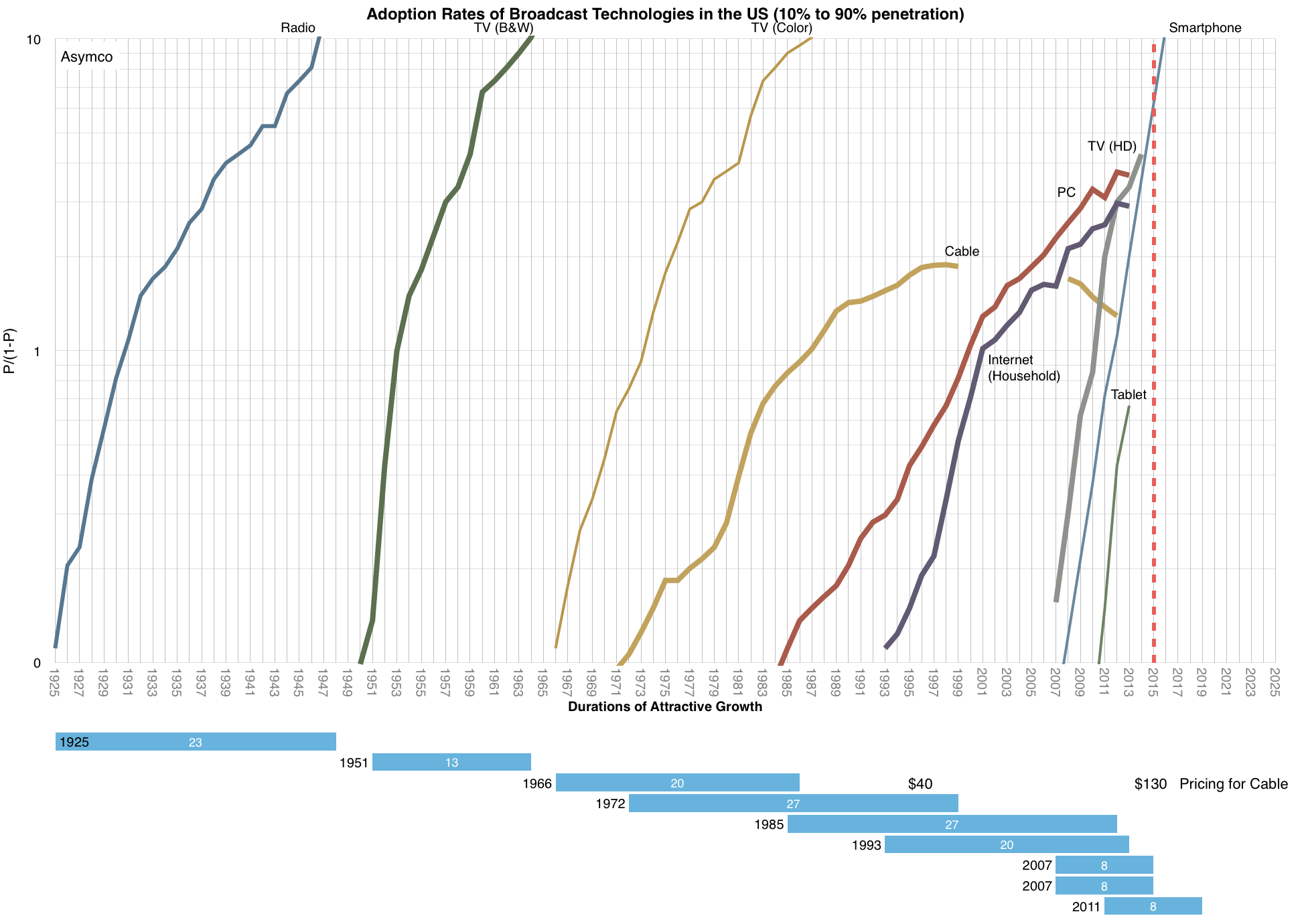
These benefits were priced modestly but as the quality and breadth of programming increased, prices rose. An average cable bill of $40/month in 1995 is $130 today. Some of that revenue went into upgrading the capital equipment and higher production values, but more went to the sports leagues and their players whose business models increasingly depended on broadcast rights.

And so over a period of about 40 years, watching TV went from free to quite expensive. More expensive even than a family’s communications costs (i.e. telephone service.) That’s quite an achievement at a time when technology disruption caused huge price reductions in other goods and services.

Over time, some of the benefits began to be less relevant. Commercials are more abundant than ever. The quality of the TV picture is actually worse due to compression than one might get with over-the-air digital broadcast. Finally, the abundance of channels is beyond anyone’s absorption rate. Those channels which used to be “pure” became polluted and undifferentiated as each tried to be the other.

On top of these paradoxes is the fact that actual penetration of the service has been declining. As the graph above shows, Cable TV has declined (though Pay TV much less so). The industry has reached saturation decades ago and has not offered anything meaningful in terms of innovation.

Disruption theory suggests that once a product over-serves on meaningful bases of value creation (and underserves on value) it opens the door to disruption. Which leads to the question. Has cable past its prime time? Twenty years have passed since the industry reached saturation and prices keep rising. The average cable bill is projected to rise to over $200/month by 2020.

This has left the industry open for disruption. Users are cutting cords, the “uncabled” or “never-cabled” are a significant portion of the population. 13.5% of broadband households with an adult under 35 have no pay-TV subscriptions. 8.6 million US households have broadband Internet but no pay-TV subscription. That’s 7.3% of households, up from 4.2% in 2010.  Another 5.6 million households “are prime to be among the next wave of cord-cutters,” according to Experian.

The same phenomenon occurred with mobile vs. fixed telephones. For several years it seemed that mobile was sustaining to fixed or that fixed was immune due to lock-ins. The fixed telephone incumbents insisted that the data was inconclusive. Then the trickle of abandonment turned into a waterfall. The quality of service for mobile kept increasing and, with data, it became clear that the mobile devices could unleash a new wave of functionality and value. The same phenomenon occurred again as the music industry shifted from CD’s to digital.

And so it goes. A business dies first slowly then quickly. The exact timing is tricky because of the non-linearity of the phenomenon. It’s also hard to declare end-of-life since business zombies will try to hold on to life as long as possible. What is clear however is that the economics will change dramatically and the alliances between talent and distribution will shift to entrants and away from incumbents. The point when we look back and say that cable as we know it was finished could come by the end of this decade.

Sling TV: A Big Step Forward for OTT


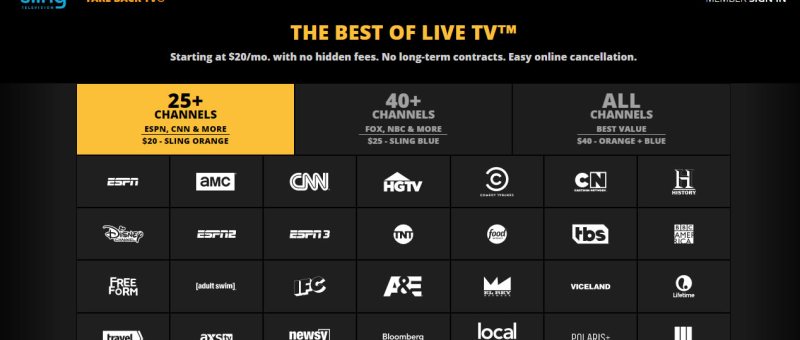
Not to be confused with the Sling Box, Sling TV is a new over-the-top television service from Dish Network that allows consumers to stream a limited number of cable channels without a cable subscription.

Hundreds of thousands of people have already preregistered for Sling TV since it was announced in January at the Consumer Electronics Show, Sling TV is offering a handful of networks, led by ESPN, for $20 a month. Other networks on the service include Food Network, HGTV, Travel Channel, CNN, TNT, TBS, Disney Channel and ABC Family.

Sling TV is aimed at “cord-nevers” who want to stream nets including ESPN and Food Network for $20 a month. With its launch, the service is also rolling out a series of apps for mobile phones, tablets, and streaming devices that hook into a subscriber’s TV.

For those who want more choices, particularly for children’s content or news, Sling TV offers bonus packs of channels for $5 a month in those categories. It also hopes to have an expanded tier of sports channels at the same price, which it says is coming soon.

The introduction of Sling TV is the beginning of the TV businesses reaction to the popularity of streaming services, led by Netflix. The number of pay-TV subscribers has been slowly shrinking and there is concern that the availability of more streaming services will accelerate the decline.

Sling TV isn’t all about streaming live TV, the service will have videos from Maker Studios in addition to live TV channels from traditional TV networks. Finally, Sling TV will also offer up a selection of video-on-demand movies and TV shows that users can purchase.

To get users watching the service, Sling TV has introduced mobile apps for the iPhone, iPad, and Android phones and tablets. It will also have apps for Amazon Fire TV, the Amazon Fire TV Stick, and the Roku 3, to allow viewers to stream live cable networks directly to their TVs.

Sling TV still isn’t my dream OTT service. It makes you buy a limited bundle of preset live channels, but does not include the broadcast networks or options to add additional channels.

The good news is that Sling TV, unlike traditional cable TV bundles, has no contracts and no upfront installation costs. Subscribers can cancel at any time, and the company is offering a one-week free trial for those who’d like to try it out before committing to it.

Unbundling Pay-TV Brings New Challenges for Media


The media industry is racing toward an Internet-TV future at a breathtaking pace. But the swift changes, highlighted by efforts from Apple Inc., Dish Network Corp. and others, are giving consumers an array of confusing options and forcing entertainment giants to confront some sober realities.

Not long ago, consumers who wanted to watch “Monday Night Football” on ESPN, “Mad Men” on AMC or “Game of Thrones” on HBO knew what they had to do: shell out for a cable package that typically costs around $90 a month in the U.S. They could catch old seasons of popular shows on Netflix or a similar streaming on-demand service, but live, up-to-date programming lived in the cable bundle.

In the span of a few months, tectonic shifts are remaking a television landscape it took decades to sculpt, opening up a range of other possibilities for “cord cutters” who don’t want traditional pay TV. Apple is working on an Internet-TV service with some 25 channels, which is expected to be priced between $25 to $35 a month, according to people familiar with its plans. It will join Dish Network Corp. and Sony Corp., which are pitching their own online-TV bundles. A host of TV companies, including HBO, NBCUniversal, Nickelodeon’s Noggin and CBS, are in the mix with stand-alone streaming offerings.

But if consumers drop pay TV and sign up for TV services delivered over broadband, will they really get a better deal?

“If you buy retail and you have six or seven of these things, that might cost you as much as a bundle that gives you 400 different networks,” said Philippe Dauman, CEO of Viacom, which earns money from bundled channels but also recently launched a subscription streaming service aimed at preschool children that it imagines will be complementary to the bundle.

Sorting through which options or combination of options to sign up for—while keeping costs from spiraling—will be a headache. Dish’s basic $20 a month streaming package will get you ESPN, TNT and some cable channels but not broadcasters CBS, NBC and Fox. Apple wants to bring customers a “skinny bundle” including broadcasters and some cable channels but its service will cost more. Sony will soon offer something more akin to a full-on cable bundle, albeit likely at a higher price than the others—and notably, for now, without Walt Disney Co.’s ESPN and ABC.

On top of all this, consumers will have to factor in the cost of their broadband access. As a reference point, one operator charges $67 a month for a speed of 25 megabits per second once its first-year promotional discount ends.

Still, the new streaming world has the potential to be “better for many consumers” because it offers choice that the pay-TV industry never provided, said Roger Lynch, chief executive of Dish’s Sling TV streaming service. For the “vast majority of all consumers, the pay-TV bundle offers good value. But there’s a growing number of consumers for whom that doesn’t work anymore,” he said.

Media giants have their own calculations to make—quickly—as they prepare for a world that will look very different in 12 months than it has for the past several decades.

For years, TV channel owners and their pay-TV distributors—cable and satellite providers—were able to count on two reliable trends: that pay-TV subscriptions in America would grow each year, and that consumers would submit to paying ever-higher cable bills. In the past two decades, the pay-TV industry has grown by about 40 million subscribers to a total of about 100 million homes, and typical cable bills increased at a compound average annual growth rate of about 6.1%, according to the Federal Communications Commission. Those dynamics produced a steady stream of subscription revenue that drove profits for Disney and Viacom Inc. just as they did for Comcast Corp. and DirecTV.

But evidence mounted over the past couple of years that something fundamental was changing. In 2013, the industry’s base of subscribers contracted for the first time. Last year, pay-TV subscriptions fell by 129,000 industrywide, according to MoffettNathanson, even as analysts said new household formation surged, typically a good sign for the industry in years past.

And besides cutting the cord, more consumers started “shaving” it, downgrading to cheaper packages that operators began to offer. Comcast, for instance, offers an “Internet Plus” package of HBO, fast broadband and local channels for $40 a month, and AT&T has been peddling a similar $49-a-month bundle that also includes Amazon.com Inc.’s Prime free-shipping and streaming-video service for a year.

A mutiny was afoot, threatening the pay-TV fortress. “The ice cube is melting,” one senior industry executive said. “It’s a reality of the marketplace.”

The TV advertising business got a shock as ratings for major cable channels plunged, particularly over the second half of last year. The Cabletelevision Advertising Bureau, an industry trade group, recently told media executives that it estimates 40% of the ratings decline was due to viewers migrating from traditional television to subscription streaming services like Netflix.

“It was happening at a pace no one was anticipating,” said an executive at one big TV network. “We said, ‘We better start finding other ways to grow.’ ”

And with that, media companies that for years had pooh-poohed cord-cutting was a real threat, began to embrace it, albeit reluctantly. HBO, owned by Time Warner Inc., announced its stand-alone Web streaming service in October, followed by CBS, while in the background Dish and Sony assembled rights for their online TV bundles.

The goal for TV channels is to carry out this experimentation while safeguarding the traditional business to the extent possible. Virtually every TV network that has launched a Web TV service says it hopes to target the roughly 10 million homes that subscribe only to broadband service—without encouraging any current pay-TV subscribers to drop their service.

But holding on to pay-TV customers is getting harder. “We think there is going to be a continual dripping, dripping, dripping of millennial consumers and poor consumers who will be outside of the big bundle,” said MoffettNathanson analyst Michael Nathanson in an interview.

One risk of the media companies’ strategy is that by bringing TV channels to the Web they aren’t thinking far enough beyond their current business models. Their real competition for young audiences in coming years will come from companies like Facebook, Vimeo and Vessel that are attracting content creators from entirely outside the pay-TV ecosystem, said Mr. Nathanson and his fellow analyst Craig Moffett.

“Our suspicion is that the millennial cord cutter isn’t waiting around for just the right package of cable channels that only their parents watch,” they wrote in a research note Tuesday.

Not every TV channel is assured a secure place in the emerging Web TV world, analysts say. The small and midtier channel owners—companies like Discovery Communications Inc., Viacom, Scripps Network Interactive, and A+E Networks—will be jockeying to make sure their networks are in the online TV bundles being marketed to the audience of the future.

Some are making headway. Discovery, owner of Discovery Channel, Animal Planet and TLC, and Viacom, owner of MTV, Comedy Central and Nickelodeon, are in talks to be on the Apple service, people familiar with the matter said. Some A+E Networks channels will be added to Sling TV’s core package by the end of March, the companies announced Tuesday.

Read More at WSJ.com

TV Ratings are Falling as SVOD Subscriptions Rise…


TV viewing in the US are on the decline and as TV ratings fall, so does TV advertising revenue, as companies like Fox have experienced this year.

Nielsen’s Q4 “Total Audience Report” released on Wednesday shows a huge drop off in traditional TV viewing as consumers shift their viewing habits from old-fashioned scheduled programming.

American adults still spend a huge amount of time watching TV each day. But the overall levels of viewing (which includes live TV + time-shifted viewing) declined 4.6% year-on-year. That’s compared to a 4.2% year-on-year decline in Q3 and a 2.1% decline in Q2. The level of decline is accelerating.

Excluding time-shifted viewing, total live TV consumption was down 5.5% year on year to 114 billion person-hours of live TV video consumption.

Nielsen time spent with TV

The Nielsen Company

Among younger audiences, the drop off in TV viewing was even more severe: 16% among 18 to 24-year-olds, and 10% among 12 to 17-year-olds.

The steep drop off of traditional TV viewing is correlated with a sharp rise in the number of US homes with access to a subscription video on demand service like Amazon, Hulu, or Netflix. Nielsen says 40% of US homes had access to a subscription video on demand service in Q4 (the pink segment in graph below), up from 36% in the same quarter the previous year.

Nielsen Subscription Video on Demand

The Nielsen Company

Of those with access to video streaming services, Netflix is the most popular option.

Nielsen Netflix Penetration

The Nielsen Company

As you may have noticed from the previous charts, the amount of media consumption per day is actually up as consumers have more choice about the way in which they view content. And the more devices and services they have, the more content they consume.

Nielsen daily screen time

The Nielsen Company

Elsewhere, the amount of time spent on the web and with apps across devices among adults over 18 years old was up 32%, according to estimates from Pivotal Research, which uses Nielsen’s data as a guide. Pivotal says this now equates to 44% of the time spent with TV versus 32% in the year-ago period (although, intriguingly, on Pivotal’s estimates, this represents a sequential decline from 48% in the third quarter.)

An opportunity for TV networks?

hbo now announced at apple event Richard Plepler, CEO of HBO

APHBO CEO Richard Plepler announcing HBO Now at the Apple event on Monday.

Brian Wieser, senior research analyst at Pivotal Research, says in a note: “While declines should level off eventually (and viewing levels would certainly look better if tablets and out-of-home viewing were included in the data; a break-out of viewing of TV content in digital environments would also probably convey something more favorable for legacy providers of TV content), a concern is that if reported viewing levels continue to fall at these levels and if the industry is unable to generally make its case for why advertisers should use the medium, marketers who might otherwise have continued to focus their spending on TV may incrementally look toward other alternatives – namely digital media at a broader level.”

However, Wieser adds that this is a “secondary concern” relative to the broader state of TV advertising, which Pivotal believes is mostly due to the fact that marketers are maintaining tighter cost controls broadly across their entire advertising budgets.

There might be new competitors in the space, but there’s also more ways to get content (and advertising) in front of viewers than ever before — and they’re actively choosing to consume more of it.

And that’s why — as ratings are getting hammered — more and more traditional TV companies are opting to launch streaming services. Most recently, HBO announced HBO Now will be available on Apple devices starting in April.

Read more